Showing posts with label Dilliebooks. Show all posts

Monday, 6 July 2020

Guest Post: History - the Most Important Timeline of All by Carol Browne...

Photo by Gustavo Fring from Pexels
Covid-19 is a game-changer in so many ways. It is making people rethink their lives, their jobs, their relationships, their aspirations, even their diets and the way they treat the planet they live on. The virus landed like a bolt out of the blue, illuminating the dark places in our lives and altering our perceptions. Many things that were thought of as important are now shown to be superficial and shallow. The way we structure our days has also come under intense scrutiny. Two areas of human activity in particular are undergoing a much-needed overhaul, and they are employment and education. People who can work from home during the lockdown can see the benefits of making this permanent. Meanwhile, many parents who have been home schooling their children are wondering if they should continue with it.

I was discussing this with a close friend of mine who has been working from home and is considering home schooling. She was concerned about peer pressure at the school one of her children attends and how it has had a detrimental effect on the child’s self-esteem. It is always hard to be different. It’s equally hard for an adult to do something different from what is considered normal. We often stick with the status quo for fear of being criticised. But, as the memes insist, the virus has shown us that normal wasn’t working. It’s time to create a new paradigm for living and my friend has seen the beneficial effects that home schooling has already had on both her children.

But this isn’t a blog about home schooling! When my friend and I were discussing different ways of educating her children, I reminded her of how we used to be taught history. We started as far back as the dinosaurs and moved forwards incrementally to the present day. As a result, I have had a mental image in my mind of every century down the ages with major events recorded on this timeline of history, so that I know where I am in the great scheme of things. I can see how mankind got to where it is today. It is like belonging to the timeline of humanity where everything makes sense, even the bad things, because wars have causes that can be traced back and great transitions, like the one we are experiencing now, can be anchored in time and better understood.

Do children still learn history this way? I meet so many young people who have no idea what happened before World War II (and don’t see the socio-economic and political factors that brought about that global conflict). Yes, they know about the Romans and perhaps the Ancient Egyptians but can’t pin them down to a particular era.

Photo by Fauxels from Pexels
And here in the UK how many of the people who are so proud to be British know anything about the history of the British Isles? Why do we use the words British and English; what’s the difference? We were a nation of immigrants long before the Roman occupation, during which time we really were British but not English. If everyone understood that we have all migrated here from other countries, would we rethink our current attitude to immigration? And if we knew more about our imperialist past with its horrors of slavery and oppression, would we see how racism developed and be better able to reject it?

Everything that happens is a lesson and the lessons of history will keep repeating on the timeline until we decide to take a stand and say no more. Only by understanding the timeline of the past can we see the need for change in the present. Allowing children to grow up without reference points or connections to ancestral knowledge, is not giving them freedom. It leaves them adrift in the modern world not knowing why things are the way they are. To teach children the lessons of history is to give them the tools they need to make their world a better place and create a brighter future.

History is important. In my book Being Krystyna – A Story of Survival in WWII I showed how intolerance for other people’s differences can lead to persecution and conflict. Krystyna herself always feared the Nazis would return, and looking at world events today I think she was right. One way to stop the resurgence of such evil is to make sure that the lessons of history are never forgotten. But first we have to learn them.

Here is a brief introduction to my book. Thank you for reading it.

It’s 2012, the year of the London Olympics, and for young Polish immigrant Agnieszka, visiting fellow countrywoman Krystyna in a Peterborough care home is a simple act of kindness. However, the meeting proves to be the beginning of a life-changing experience.

Krystyna’s stories about the past are not memories of the good old days but recollections of war-ravaged Europe: The Warsaw Ghetto, Pawiak Prison, Ravensbrück Concentration Camp, and the death march to freedom.

The losses and ordeals Krystyna suffered and what she had to do to survive, these are horrors Agnieszka must confront when she volunteers to be Krystyna’s biographer.

Will Agnieszka find a way to accomplish her task, and, in this harrowing story of survival, what is the message for us today?

Buy Links

Born in Stafford in the UK, Carol Browne was raised in Crewe, Cheshire, which she thinks of as her home town. Interested in reading and writing at an early age, Carol pursued her passions at Nottingham University and was awarded an honours degree in English Language and Literature. Now living and working in the Cambridgeshire countryside, Carol usually writes fiction and is a contracted author at Burning Willow Press. Being Krystyna, published by Dilliebooks on 11th November, 2016, is her first non-fiction book.

Stay connected with Carol on her website and blog, Facebook, and Twitter.

Thursday, 14 May 2020

New Release: WYRD'S END, Book 3 in The Elwardain Chronicles by Carol Browne...

WYRD'S END, Book III in The Elwardain Chronicles series written by gifted epic fantasy author Carol Browne, is now live! The books in this trilogy are packed with action and adventure. Be sure to get your copies today!

Determined to spare Godwin the violent death shown to her in dreams, Elgiva uses the portal to cross over into his dimension.

Meanwhile, members of Godwin’s tribe seek sanctuary at the settlement. What has caused them to flee for their lives? 

Disguises must be lifted and secrets revealed and wyrd will unfold as it should.

But time is running out…

For it is winter and the darkness is coming;

A darkness with teeth and claws.

BUY LINKS

Born in Stafford in the UK, Carol Browne was raised in Crewe, Cheshire, which she thinks of as her home town. Interested in reading and writing at an early age, Carol pursued her passions at Nottingham University and was awarded an honours degree in English Language and Literature. Now living and working in the Cambridgeshire countryside, Carol usually writes fiction but has also taken a plunge into non-fiction with Being Krystyna. This story of a Holocaust survivor has been well received.

Stay connected with Carol on her website and blog, Facebook, and Twitter.

Monday, 2 March 2020

Finding My Superpower by Author Carol Browne...

The day I discovered my superpower is a memory undimmed by time. It was a life-changing event and I doubt I will ever forget it. Some of the details are sketchy, though, like how old I was. I know I was in my first year of primary school so I must have been about seven.

Photo by Miguel Bruna on Unsplash
I can still see the classroom, the table where I was sitting when it happened, and the chalk-smeared blackboard, but apart from the teacher being female, I don’t recall much about her. I regret that because I have never been able to thank this woman for making me aware of a talent I didn’t know I had. She set me on a path I am still following almost sixty years later.

It all started when I wrote a poem. Where did I get the idea from to do that? It’s a mystery, and it seems strange to me now that I even knew what a poem was, or that it should have meter and rhyme. I also wrote it in verses of four lines each. The subject was a crocus, something I must have seen and wondered at, but again I’ve no idea why this little plant should have inspired me to put pen to paper the way I did, nor why I chose to present the poem to my teacher. Having composed this no doubt unsophisticated piece of doggerel, that was that as far as I was concerned. I didn’t expect what was to follow.

I was at my table, scribbling away with one of those thick blue biros they used to hand out, when the teacher announced that Carol Browne had written a wonderful poem and it was going on the wall so everyone could see it. In fact, she advised my classmates to look at it if they wanted to know how to write a poem. She came over to me and congratulated me on my work and I was astonished, delighted and taken aback by this praise and recognition. As a shy and lonely child with physical defects only time would cure, I found myself suddenly elevated to a status I could not have aspired to in my wildest dreams. I never received validation for anything before but now I was worthy because of a talent not everyone else possessed. I could manipulate words. I could bend them to my will. I could do this because I was a wordsmith. This was my gift, my specialty. This was my superpower.

From that moment on I was a writer.

Here's a brief intro to my latest fantasy released through dilliebooks. I hope you like it.


Elgiva, a young elf banished from Elvendom, must seek shelter among the Saxons as her only hope of surviving the coming winter.

Godwin, a Briton enslaved by the Saxons, is a man ignorant of his own inheritance and the secret of power he possesses.

A mysterious enemy, who will stop at nothing to wield absolute power over Elvendom, is about to make his move.

When destiny throws Elgiva and Godwin together, they embark upon the quest for the legendary Lorestone, the only thing that can save Elvendom from the evil that threatens to destroy it.

There is help to be found along the way from a petulant pony and a timid elf boy but, as the strength of their adversary grows, can Elgiva’s friends help her to find the Lorestone before it falls into the wrong hands?


Born in Stafford in the UK, Carol Browne was raised in Crewe, Cheshire, which she thinks of as her home town. Interested in reading and writing at an early age, Carol pursued her passions at Nottingham University and was awarded an honours degree in English Language and Literature. Now living and working in the Cambridgeshire countryside, Carol usually writes fiction but has also taken a plunge into non-fiction with Being Krystyna. This story of a Holocaust survivor has been well received.

Stay connected with Carol on her website and blog, Facebook, and Twitter.

Monday, 11 November 2019

Guest Post: Remembering the Importance of Trees by Carol Browne...

I’m a tree hugger and always have been. There’s something in my nature that draws me to them like old friends. How gratifying it is for me to see so many other people waking up to how important and precious trees are.

Photo by Studio Dekorasyon on Unsplash
Every oxygen-breathing organism on Earth benefits from the work done by these forest denizens. Their fallen leaves not only nourish the ground they stand in but also feed a network of fungi, plants and small critters essential to the circle of life. The trees hold the land in their roots, preventing soil erosion and landslides. They suck up water and protect the land from flooding. They provide shade, shelter and homes to countless animals, birds and insects. They give us fruit, nuts and medicine; wood for building and fuel. In the rainforests they even create their own weather.

Trees are amazing. And now we need them more than ever. Their ability to capture carbon from the air, to use and store it, while releasing life-affirming oxygen, is vital in the battle against climate change.

We must plant more trees. Anyone with a garden can do that. If you can’t, donate to an organization that will plant trees on your behalf and support campaigns to protect ancient woodland.

We have lost our connection with Nature, that fellowship experienced so profoundly by our ancestors. For far too long we have looked down upon primitive cultures that talked about nature spirits and the wisdom of trees. We dismissed the Druids for worshipping trees. It was all superstition. But we were wrong. The trees have been our allies all the time, even when we turned our backs on them. They remained the guardians of the planet and quietly went about the business of preserving its ecosystem. Now it is imperative we embrace them again as our friends and rediscover that lost connection, before it is too late.

There is a close relationship between trees and writers; don’t they provide us with the paper on which we write our stories? They can even give us the ink to write them with. Ink made from oak galls was favoured by scribes during the Middle Ages and Renaissance because of its permanence and resistance to water and it still enjoys a niche market today among artists.

Born in Stafford in the UK, Carol Browne was raised in Crewe, Cheshire, which she thinks of as her home town. Interested in reading and writing at an early age, Carol pursued her passions at Nottingham University and was awarded an honours degree in English Language and Literature. Now living and working in the Cambridgeshire countryside, Carol usually writes fiction, but dabbles in non-fiction and is a contracted author with Dilliebooks.

 Stay connected with Carol on her website and blog, Facebook, and Twitter.

Being Krystyna; A story of survival in WWII

It’s 2012, the year of the London Olympics, and for young Polish immigrant Agnieszka, visiting fellow countrywoman Krystyna in a Peterborough care home is a simple act of kindness. However, the meeting proves to be the beginning of a life-changing experience.

Krystyna’s stories about the past are not memories of the good old days but recollections of war-ravaged Europe: The Warsaw Ghetto, Pawiak Prison, Ravensbrück Concentration Camp, and the death march to freedom.

The losses and ordeals Krystyna suffered and what she had to do to survive, these are horrors Agnieszka must confront when she volunteers to be Krystyna’s biographer.
Will Agnieszka find a way to accomplish her task, and, in this harrowing story of survival, what is the message for us today?

Buy Links Dilliebooks - Amazon UK - Amazon US

Monday, 29 July 2019

Guest Post: 6 Tips to Help Authors Prepare for their First Book Signing by Carol Browne...

If like me you are introverted and social phobic, a book signing will be a very scary proposition. In my case I also live in a rural area without access to transport so just getting to a book signing event is a challenge. I was an eBook author for the first couple of years of my career too and so I didn’t have a book to sign anyway. This year, I did my first book signing courtesy of my supportive boss and his wife who not only allowed me to use part of their establishment (the pub where I work) but provided coffee and cakes for the people who attended.

A writer’s life might appear to be very glamorous to outsiders, but it’s usually quite the opposite. I do a variety of jobs to keep from starving in a garret and they are mostly very menial: cleaning and washing up, for example. And when I attended this, my first real book signing, I didn’t roll up in a Porsche, I had to walk there dragging my paperbacks behind me in a shopping trolley. Even with wheels, that thing got damn heavy after the first fifteen minutes. I had nearly forty books in it—well, I had no idea how many to take.

Of course I was nervous but it turned out better than I expected. I sold twenty books and met some very interesting people. They all seemed so pleased to be there, and to be meeting me! Suddenly Cinderella had gone to the ball and she could forget about the washing up and the cleaning for a while.

It was Holocaust Memorial Day in Britain on the 27th and so I was specifically promoting my book Being Krystyna—A Story of Survival in WWII. I discovered when I spoke to people at the event just how many of them have interesting stories to tell, especially about the war. One woman said her mother was born in a Japanese POW camp and the other female prisoners pooled their resources to provide food and clothing for the baby. I found out that my boss’s grandfather had been a prisoner of the Japanese too for three years. There are so many stories we shall never know about, stories of heroism and endurance.

Here are some more things I learned at the event that it is useful to share with other authors yet to experience a book signing:

1. Take book swag—postcards, bookmarks, etc.—because people love to get a freebie and they might pass them on to someone else. While I was promoting my non-fiction book, I handed out postcards that publicised my fantasy novel.

2. Have change ready for people who pay cash, as most will. You certainly don’t want to be taking cheques and if you’re like me you won’t have credit card capabilities! (My book was £4.99 and I had a stash of pennies in anticipation of all the five pound notes I was going to get, and did.)

3. Practise your signature before the event unless you’re that lucky person who has a naturally lovely and easily written moniker. Mine is a disappointment and that was a worry to me—who wants a spider scrawl on the first page of their pristine new book? And make sure you have a decent pen (and a replacement), one that’s not going to run out halfway through your signature or spit gouts of ink onto the paper. (I’m pleased to say, I was surprised and gratified at how my signature worked out on the day!) Don’t know what to write? Ask the person who the book is for (make sure to get the correct spelling) and simply put ‘To …., Best Wishes’ and then your signature.

4. Don’t worry that you’ll run out of books. You can always take people’s names and addresses. (I took a book of receipts in case people paid up front but as it turned out I didn’t need them.) If you are involved in advertising the event beforehand, you can suggest people buy your book first and bring it with them to be signed.

5. Have business cards to hand out. This was something I didn’t get round to. I didn’t have flyers or attractive posters either. And what that taught me was that next time I will be better prepared, but that it doesn’t spell disaster because most people who want to come to a book signing are coming to see you, the author, not all the bells and whistles you have brought with you. (People were so delighted to be given a mere postcard, you’d think I was handing out bank notes!).

6. Most importantly, stop worrying about everything having to be perfect. You have a talent to be proud of and you have achieved something most people haven’t. Enjoy that feeling of being recognised as a creative individual but at the same time remember that you are still just a human being and you can only do your best and no more. Don’t be afraid of doing a book signing either. Feel the fear and do it anyway.

If I can do it, anyone can. The important thing is, just have fun!

Here is a brief introduction to my book. Thank you for reading it.

It’s 2012, the year of the London Olympics, and for young Polish immigrant Agnieszka, visiting fellow countrywoman Krystyna in a Peterborough care home is a simple act of kindness. However, the meeting proves to be the beginning of a life-changing experience. Krystyna’s stories about the past are not memories of the good old days but recollections of war-ravaged Europe: The Warsaw Ghetto, Pawiak Prison, Ravensbrück Concentration Camp, and the death march to freedom.

The losses and ordeals Krystyna suffered and what she had to do to survive, these are horrors Agnieszka must confront when she volunteers to be Krystyna’s biographer.

Will Agnieszka find a way to accomplish her task, and, in this harrowing story of survival, what is the message for us today?

Buy Links


Born in Stafford in the UK, Carol Browne was raised in Crewe, Cheshire, which she thinks of as her home town. Interested in reading and writing at an early age, Carol pursued her passions at Nottingham University and was awarded an honours degree in English Language and Literature. Now living and working in the Cambridgeshire countryside, Carol usually writes fiction and is a contracted author at Burning Willow Press. Being Krystyna, published by Dilliebooks on 11th November, 2016, is her first non-fiction book.

Stay connected with Carol on her website and blog, Facebook, and Twitter.

Monday, 16 July 2018

Guest Post: Elves - the Good, the Bad, and the Awesome by Carol Browne...

Photo Courtesy of Fun Photos Pixabay
When Elgiva, the protagonist of my fantasy novel The Exile of Elindel, is forced to seek the society of humans in order to survive the winter, she can only do this by adopting a disguise. Although mythology insists that elves are shapeshifters, I have Elgiva borrow magic instead so she can change her appearance. Why would she need to do this? In these modern times, we have friendly elves that help Santa; we have the innocuous Elf on the Shelf; we have glamorous immortal beings like the elves in "Lord of the Rings" that fascinate us with their pointed ears and otherworldly beauty. Why on earth would an elf feel compelled to hide their true nature?

Belief in elves as actual beings is as old as belief in the Norse gods. Indeed Freyr, one of the gods most widely and ardently venerated by the Norse and Germanic peoples, dwelled in Alfheim, the elves’ homeland. Germanic Mythology described three divine races: the Aesir, the Vanir and the Alfar (the elves). The origins of the Vanir and Alfar are cloaked in mystery and the relationship between the gods and the elves was ambiguous enough to permit a number of possible connections between Freyr and the elves.
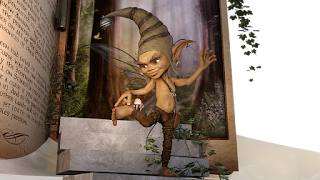
Photo Courtesy of The Royalmen Pixabay
However, godlike or not, elves were often seen as mischievous and spiteful, if not downright dangerous, liable to lash out with magic if crossed. For example, the word 'stroke' for a sudden paralysing seizure is an abbreviation of 'fairy stroke' or 'elf stroke' and was supposed to come from being elf-shot, a blow which struck down an animal or human victim. Similarly, cramps were often the punishment for annoying the elven folk. The Anglo-Saxons recognized being elf-shot as a valid condition and thought it was caused by unseen elves firing invisible arrows at a person or animal, causing sudden shooting pains in a particular part of the body. And should a person’s hair become matted or knotted, he or she was said to be sporting elf-locks, that some unhelpful elf had tangled up. This was particularly said of the hair of sleeping children. And keep an eye on those children, for elves like to steal them!

Given their capricious and magical nature and supernatural origins, it is no wonder the Anglo-Saxons feared them. So Elgiva could not have strolled into a human settlement with impunity and was compelled to cloak herself in enchantment in order to pass as a human.

Scandinavian folklore boasts an abundance of elves, trolls and other mythological creatures. Most people in Denmark, Norway, and Sweden haven't taken any of them as fact since the 19th century, but it’s a different story in Iceland. Surveys taken there even in the present century revealed that more than half those surveyed believed in elves, while a number of major road construction projects have been halted, thanks to protestors concerned about the deleterious effects it would have on the habitat and culture of the resident elves.

Elves have been part of our folklore for a very long time. How we have interpreted them down the ages has varied tremendously. They originated as demi-gods, became malicious and belligerent, then friendly and industrious, and now they feature heavily in fiction and popular culture. They may be light elves. They may be dark elves. One thing is certain, good or bad, elves are always cool!

How about curling up with my epic fantasy while you contemplate the possibility of elves?

Elgiva, a young elf banished from Elvendom, must seek shelter among the Saxons as her only hope of surviving the coming winter.

Godwin, a Briton enslaved by the Saxons, is a man ignorant of his own inheritance and the secret of power he possesses.

A mysterious enemy, who will stop at nothing to wield absolute power over Elvendom, is about to make his move.

When destiny throws Elgiva and Godwin together, they embark upon the quest for the legendary Lorestone, the only thing that can save Elvendom from the evil that threatens to destroy it.

There is help to be found along the way from a petulant pony and a timid elf boy but, as the strength of their adversary grows, can Elgiva’s friends help her to find the Lorestone before it falls into the wrong hands?

EXCERPT

The night was waning when Elgiva woke, wondering where she was. The dark ceiling of Joskin’s cave hung above her, and everything had a reddish glow, cast by the embers of the fire. She slid from under the fur coverlet, her skin tightening at the loss of its warmth, and searched for her leather sandals.
Something had woken her, something that waited outside the cave. A runnel of dread ran down her spine.
She had an inexplicable sense of impending danger, but it was too insistent to ignore. An unnamed instinct stopped her from alerting her companions. She must face this menace alone.
She left the cave as quietly as she could. Her heart pounded in her throat as she peered between the rowan trees and searched the night. Whatever had awakened her, it beckoned. She held her breath and listened, but her ears detected nothing, save for a silence as dark and empty as an abandoned crypt.
It would soon be daybreak, but the sun had yet to rise, and the dark beyond the cave swarmed with potential horrors. She stepped out from among the rowans, relying on her acute senses to make out her surroundings. An unnatural calm gripped the night and as her sandals whispered against the cold grass, they sounded abnormally loud. She feared they would betray her presence.
After a while, she came to a stop and searched the trees. Thin strands of mist curled along the ground, cold and clammy, like an exhalation of sickness.
She hugged her shoulders, knotted her fingers in the cascade of her hair, and shivered in her ragged robe. All around her, the silence seemed to be drawing into focus.
“Who is it?” Her throat was too dry for her purpose. She swallowed and licked her lips. “Who’s there? I know you’re there. I can . . . I can feel you!” 
Feel you.
A flash of silver sliced through the dark, and Elgiva gasped in fear. Her arms came up to shield her face as the beam struck a rock several yards ahead. It exploded with a whoosh and sent up thousands of splinters of light, which fell to the ground and sizzled in the mist.
A shape now stood upon the rock, its form concealed in a black, hooded cloak.
Elgiva clutched the amulet to her breast. Her hands were white with terror. “In the name of Faine, who are you? What sort of trick is this?”
A soft, sly voice spoke back to her. “Why should you fear magic?”
“What do you want?” she pleaded, her voice a croak of fear.
“To see for myself.”
“To see what?”
The dark shape sniggered, but made no answer. Instead, it swept its cloak aside, and a cloud of sparks flew out and covered the ground with beads of light.
Elgiva stepped back unsteadily, resolved to flee.
“Stay!” commanded the creature.
It raised a skeletal hand, and the forefinger swung towards Elgiva and pinned her against the darkness, holding her like a rivet of bone. No elf, no wilthkin, ever owned such a hand. Her legs threatened to buckle beneath her. This had to be a nightmare; she was still asleep in the cave. But no, it was all too real.
“Who are you? What do you want?” she cried. “I have . . . I have an amulet!”
The creature laughed derisively. “I am Death, and I have come for you.”
It began to radiate a sickly green light, enveloping itself in a caul of brilliance that pulsated with force. The light grew in size until the trees behind it were bathed in its angry glare. It reached for Elgiva, like a foul stench creeping along a breeze, and she was helpless. The creature’s power throbbed in the darkness.
Within the taut coils of her fear, her instincts screamed at her to run, but her limbs had turned to stone.
Siriol, Siriol, help me . . . help . . .
With a shriek of glee, the creature increased the throb of its power. Elgiva’s mind was suddenly invaded by an inexplicable force. She became divorced from herself and watched from a great distance, waiting for the horror to unfold.

Born in Stafford in the UK, Carol Browne was raised in Crewe, Cheshire, which she thinks of as her home town. Interested in reading and writing at an early age, Carol pursued her passions at Nottingham University and was awarded an honours degree in English Language and Literature. Now living and working in the Cambridgeshire countryside, Carol usually writes fiction and is a contracted author at Burning Willow Press. Her non-fiction book is available at Dilliebooks.

Stay connected with Carol on her website and blog, Facebook, and Twitter.

Monday, 17 July 2017

The Dunkirk Spirit: A Lesson from History By Carol Browne...


Let me begin by setting the scene …

The summer of 1940 finds the beaches around Dunkirk, France filled with hundreds of thousands of British troops trapped and with no hope of escape. Behind them is the vastly superior German army with its engines of war. Before them lies the cruel sea. Above them the relentless strafing of enemy aircraft.

Despite overwhelming odds, the men of the British Expeditionary Force and their Belgian and French allies fight to defend their positions but, with all escape routes blocked, a desperate retreat to the beaches and harbour at Dunkirk is the only option left.
The only thing these men want is to get to England, home, and safety. They placed their faith in the navy. Operation Dynamo has been set in motion to evacuate them, even though the transport ships and destroyers can only expect to have enough time to rescue about 30,000 troops. But soon, repeated attacks from the enemy’s aircraft block the harbour with sinking ships. The soldiers must be evacuated from the beaches. How is this possible in such shallow water?

What happened next will leave a permanent impression upon the British psyche, for when the call went out that small boats were needed to rescue the troops, a motley fleet of plucky ‘little ships’ chug its way across the Channel to bring the warriors home. They are motor boats, trawlers, paddle steamers, fishing smacks, lifeboats, barges, and other shallow-draught vessels. The majority of them are privately owned. Many are taken across by naval personnel, but an equal number are crewed by their owners and other civilians eager to stand by their country during its darkest hour.

Braving the combined onslaughts of the German army and air force, these civilians risk their lives again and again to take troops from the beaches and ferry them to the destroyers waiting in deeper water. Some of these boats will take thousands of men all the way back to England. Thanks to their efforts, a total catastrophe will be averted. It will be described by Winston Churchill as a “miracle of deliverance” and what takes place at Dunkirk from May 27th to June 4th, 1940, will live in the hearts and minds of the British people for many generations to come. At a time when Great Britain faces certain invasion, recovering over a third of a million troops has turned defeat into victory. The phrase “the Dunkirk spirit” is born.
****
The Dunkirk spirit. This is a phrase I have heard many times during my life. If you are British, it needs no explanation and yet as the event that created it moves further back in time, I fear that new generations would have no knowledge of it and an important part of my country’s heritage will be lost. I am delighted, therefore, to see that a new movie about Dunkirk is to release this summer. Not only will people much younger than me know about the Dunkirk spirit, but so will people of other countries, and a valuable historical lesson will continue to inspire us all.

What is the lesson? During these uncertain and divisive times, it resonates as much as ever. It shows us what we can achieve when we cooperate. It demonstrates how brave and selfless ordinary folk can be. We are all capable of far more than we know and when individuals work together for the common good, the tide will turn, and even in the most hopeless and desperate of situations, defeat can be transformed into victory. Because the Dunkirk spirit is the human spirit at its best and nothing can stand in its way.

Sharon here to bring you another true story of strength from the same war. Amazing what people can survive when they have spirit.


It’s 2012, the year of the London Olympics, and for young Polish immigrant Agnieszka, visiting fellow countrywoman Krystyna in a Peterborough care home is a simple act of kindness. However, the meeting proves to be the beginning of a life-changing experience. Krystyna’s stories about the past are not memories of the good old days but recollections of war-ravaged Europe: The Warsaw Ghetto, Pawiak Prison, Ravensbrück Concentration Camp, and the death march to freedom.

The losses and ordeals Krystyna suffered and what she had to do to survive, these are horrors Agnieszka must confront when she volunteers to be Krystyna’s biographer.

Will Agnieszka find a way to accomplish her task, and, in this harrowing story of survival, what is the message for us today?

Buy Links Dilliebooks - Amazon UK - Amazon US

Born in Stafford in the UK, Carol Browne was raised in Crewe, Cheshire, which she thinks of as her home town. Interested in reading and writing at an early age, Carol pursued her passions at Nottingham University and was awarded an honours degree in English Language and Literature. Now living and working in the Cambridgeshire countryside, Carol usually writes fiction and is a contracted author at Burning Willow Press. Being Krystyna, published by Dilliebooks on 11th November, 2016, is her first non-fiction book.

Stay connected with Carol on her website and blog, Facebook, and Twitter.

Ready to learn more from those plucky Brits? Here's the official movie trailer for Dunkirk, released July 21, 2017:

Monday, 24 April 2017

Heroes of the Holocaust…

Entrance to a death camp. Translation: Work Brings Freedom
April 24th marks Holocaust Remembrance Day. To honour this day, I approached my author friend, Carol Browne, who wrote a book about a Holocaust survivor, to ask if she’d like to get together to do an article about two people who had survived the Holocaust and made a substantial difference in this world. Carol was totally on board, so we put our heads together, and these are the two heroic people we chose…

Carol’s hero:

Elie Wiesel
Born in Sighet, Romania on 30th September, 1928, Elie Wiesel was a student of religion. In 1940 his family was forced to live in a Jewish ghetto, along with many others, but worse was to come in May, 1944, when Jews living in Sighet were deported to Auschwitz concentration camp. Elie was then aged fifteen. He and his father were used as slave labourers there before being sent on a forced march to Buchenwald, where his father was so badly beaten by a German soldier he died. The camp was liberated three months later and Elie was free, but he had lost his parents and youngest sister to the Holocaust. His two older sisters miraculously survived.

Elie was a student at the Sorbonne, 1948-51, and began a career in journalism. In 1960 his book La Nuit (Night) was published. It told of his experiences during the Holocaust and became an international bestseller. Two novels followed: Dawn (1961) and Day (1962). Altogether these books comprised a trilogy that looked closely at man’s inhumanity to man.

Wiesel became an American citizen in 1963. He went on to write many books and became a revered activist and public orator, speaking out against injustices all over the world. In 1978, Jimmy Carter appointed him as chair of the President's Commission on the Holocaust. Among his many awards were the U.S. Presidential Medal of Freedom and the French Legion of Honour's Grand Croix. He held teaching posts at a number of universities and, together with his wife Marion, founded the Elie Wiesel Foundation for Humanity, to combat the intolerance and injustice that so concerned him.
In 1986, Wiesel’s activism finally won him the Nobel Peace Prize.

On July 2, 2016, Wiesel died at his home in Manhattan, aged 87. In spite of horrendous experiences in the death camps, he had not lost his faith in humanity and never failed in his duty to his fellow man. To quote the citation of his Nobel Peace Prize, “Wiesel is a messenger to mankind. His message is one of peace, atonement and human dignity. His belief that the forces fighting evil in the world can be victorious is a hard-won belief.”

Sharon’s hero:

Otto and Anne Frank
You may have heard of Otto Heinrich Frank through his famous daughter, Anne. After his liberation from Auschwitz, Otto made his way back to Amsterdam, June 3rd, 1945, to find out that his wife and later his two daughters had perished in the death camps. Otto slowly learned to live with his grief. “There is no point in brooding”, he wrote to a friend on March 16, 1946. “We have to go to living, go on building. We don’t want to forget, but we mustn’t let our memories lead us to negativism.”

On the same day Otto Frank learned of his daughters’ deaths, Miep Gies, a trusted employee and dear friend, gave him Anne’s red-and-light-green checkered diary, her notebooks, and 327 loose sheets of onionskin paper Miep had rescued and kept safe in her desk drawer. Otto went to work on putting the papers in some kind of order, and typed out a manuscript which he had professionally edited. After Otto gave a copy of the corrected manuscript to several friends and relatives to read, he was urged to publish the diary by a professor friend, who said, “It was the most moving document about that time I know, and a literary masterpiece.”

Originally published with the title Het Achterhuis (The House Behind) in March 1947, the first American edition appeared in 1952 under the title Anne Frank: The Diary of a Young Girl. Believe it or not, the diary didn’t become a bestseller until it was adapted for the stage and performed throughout the world. On May 3, 1957, the Anne Frank Foundation was established to preserve the building (263 Prinsengracht) where the Franks hid during the war. Otto Frank insisted that the foundation also establish a centre that would promote contact among young people of different countries and religious backgrounds to prevent intolerance and discrimination. On May 3, 1960, the Anne Frank House opened as a museum and to this date receives over a million visitors each year. In the end, the Nazi terror could not silence Anne’s voice, thanks to her father’s deep devotion to bring Anne’s words out into the world.

About the Authors:

Born in Stafford in the UK, Carol Browne was raised in Crewe, Cheshire, which she thinks of as her home town. Interested in reading and writing at an early age, Carol pursued her passions at Nottingham University and was awarded an honours degree in English Language and Literature. Now living and working in the Cambridgeshire countryside, Carol usually writes fiction and is a contracted author at Burning Willow Press. Being Krystyna, published by Dilliebooks on 11th November, 2016, is her first non-fiction book.

 Stay connected with Carol on her website and blog, Facebook, and Twitter.

Being Krystyna; A story of survival in WWII

It’s 2012, the year of the London Olympics, and for young Polish immigrant Agnieszka, visiting fellow countrywoman Krystyna in a Peterborough care home is a simple act of kindness. However, the meeting proves to be the beginning of a life-changing experience.

Krystyna’s stories about the past are not memories of the good old days but recollections of war-ravaged Europe: The Warsaw Ghetto, Pawiak Prison, Ravensbrück Concentration Camp, and the death march to freedom.

The losses and ordeals Krystyna suffered and what she had to do to survive, these are horrors Agnieszka must confront when she volunteers to be Krystyna’s biographer.
Will Agnieszka find a way to accomplish her task, and, in this harrowing story of survival, what is the message for us today?

Buy Links Dilliebooks - Amazon UK - Amazon US

Sharon Ledwith is the author of the middle-grade/young adult time travel adventure series, THE LAST TIMEKEEPERS, and the teen psychic mystery series, MYSTERIOUS TALES FROM FAIRY FALLS. When not writing, researching, or revising, she enjoys reading, exercising, anything arcane, and an occasional dram of scotch. Sharon lives a serene, yet busy life in a southern tourist region of Ontario, Canada, with her hubby, one spoiled yellow Labrador and a moody calico cat.

Learn more about Sharon on her WEBSITE and BLOG. Stay connected on FACEBOOK, TWITTER, GOOGLE+, and GOODREADS. Check out THE LAST TIMEKEEPERS TIME TRAVEL SERIES Facebook page.

The Last Timekeepers and the Dark Secret, Book #2:

Fourteen year-old Jordan Jensen always considered himself a team player on and off the field, until the second Timekeeper mission lands him in Amsterdam during World War Two. Pulled into the world of espionage, torture, and intolerance, Jordan and the rest of the Timekeepers have no choice but to do whatever they can to stay one step ahead of the Nazis in order to find and protect a mysterious book.
With the help of the Dutch Resistance, an eccentric baron, Nordic runes, and an ancient volume originating from Atlantis, Jordan must learn that it takes true teamwork, trust, and sacrifice to keep time safe from the evils of fascism. Can Jordan find the hero within to conquer the darkness surrounding the Timekeepers? If he doesn’t, then the terrible truth of what the Nazis did will never see the light of day.

Monday, 13 February 2017

Book Review: Being Krystyna by Carol Browne…

When Carol Browne volunteered to write the life story of local woman, Krystyna Porsz, she was a very reluctant biographer. Ms. Browne did it because no-one else could be found to do it, so she thought, “If I don’t do it, no-one will.” And I for one, am glad she did manage to put pen to paper and write Krystyna’s story!

There are many books out there that share the horrific tales of Holocaust survivors and the aftermath of what these courageous human beings had to go through during World War Two. Being Krystyna is one of those books. Carol Browne only met Krystyna once but made a point of shaking her hand before she left. Carol states openly, “I needed to physically touch someone who had survived the Holocaust, who had lived a history I had only read about or seen on black and white newsreels.”

So what’s my take on this true story of a strong woman whose voice needed to be heard despite being seriously hampered by dementia? This is what I posted on Amazon and Goodreads…

A 4 Star Tribute to a True Survivor…

Bravo to Carol Browne for writing a poignant, well-told story of a survivor of the Holocaust during World War Two. Browne captures the voice and tone of the aging Krystyna, and brings her story to life. A well-done tribute to a woman who went through hell to ensure her survival and live a long, productive life.

Being Krystyna would do well on the laptops of today’s students to allow them a peek into Krystyna’s world, and what it was like to walk in her shoes. This biography is a true triumph of the human spirit, and I was humbled to read Krystyna’s courageous story.

About the Book:

In 2012 when young Polish immigrant Agnieszka visits fellow countrywoman Krystyna in a Peterborough care home for the first time, she thinks it a simple act of kindness. However, the meeting proves to be the beginning of a life-changing experience.

Krystyna’s stories about the past are not memories of the good old days but recollections of war-ravaged Europe: The Warsaw Ghetto, Pawiak Prison, Ravensbrück Concentration Camp, and a death march to freedom.

The losses and ordeals Krystyna suffered and what she had to do to survive are horrors Agnieszka must confront when she volunteers to be Krystyna’s biographer.

Will Agnieszka be able to keep her promise to tell the story, and, in this harrowing memoir of survival, what is the message for us today?

Purchase Links:

 
Carol Browne regards Crewe, Cheshire, as her home town and graduated from Nottingham University in 1976 with an honors degree in English Language and Literature. Carol writes speculative fiction, non-fiction, and poetry. She is also a ghost blog writer, proofreader, copy editor, and copywriter. 

Along with a passion for gardening, Carol is an avid animal lover. Carol lives in the Cambridgeshire countryside with her dog, Harry, and cockatiel, Sparky. Pagan and vegan, Carol believes it is time for a paradigm shift in our attitude to Mother Nature and hopes the days of speciesism are numbered.

Connect with Carol on her website and blog, Facebook, and Twitter.