Showing posts with label History. Show all posts

Sunday, 26 October 2025

The History of Halloween by Paranormal Romance Author C.D. Hersh...

 
Most people think of Halloween as a holiday for trick or treating, dressing up in costumes, a time for ghouls, ghosts and monsters to roam, a celebration of the harvest, or an excuse to have a really scary party.

In reality, Halloween has its roots in four religious holidays, three that deal with death:

• The celebration of the Celtic Druidic holiday Samhain

• The celebration of the pre-Christian Roman goddess Pomona

• The Roman festival of Feralai

• And Christianity’s All Hallow’s Eve, also called All Saints’ Eve

Samhain, celebrated on October 31st, marked the end of summer and the beginning of winter for the Celts. Druid priests performed ceremonies in honor of their sun god Baal, whom they thanked for the harvest and asked for support to battle the coming winter. They also believed that the veil between the world of the living and the dead was opened during the celebration of Samhain, and the souls of the dead roamed the earth. The ghosts were believed to play tricks on the living and cause supernatural events to happen, the origins of today’s belief that ghosts and ghouls roam freely on Halloween evening.

The Roman celebrations honoring the goddess Pomora and the festival of Feriala were also held in late October. Pomora was the goddess of fruits and trees. The use of these fruits for fortune telling stems back to her celebration. The feast of Feriala honored the dead, much like the Celts’ Samhain festival.

The Christian festival of All Hallow’s Eve is a celebration honoring the dead saints and martyrs of the church.

When the Romans conquered the Celts their autumn festivals and the Celts autumn festivals were combined until the Romans decided too many of their Roman citizens were adopting the Celtic religion. Rome’s answer to this problem was to ban the Druidic religion and kill its priests. However, the Romans could not wipe out the old Celtic beliefs and many people continued to keep the traditions alive.

When the Christians came into power they, too, wanted to do away with the very popular, old pagan rites. So, the church moved their feast of the saints (which was held in May) to November 1st , and later to October 31st, in an attempt to absorb the ingrained Samhain traditions and rites into a Christian holiday. By doing so they hoped to hold onto their new followers by allowing them to celebrate a festival on a date they had long held sacred. Once they had established the new Christian festival the church tried to discourage the old practices in favor of more Christian ones, but, like the Romans, they were not successful.

Using Christian holidays to absorb pagan ones was a tactic the church used often. Elements of pagan celebrations can be found in Valentine’s Day, Easter and Christmas celebrations. Over the years, most of the pagan holiday traditions in these celebrations were christianized. Not so with Halloween. Both the Roman Catholic Church and the Puritan founding fathers of America, who banned the celebration in the New World, could not christianize this pagan holiday.

It’s no wonder that Christianity hasn’t been able to overcome the pagan elements of Halloween. Celebrating all that death seems to be a perfect transition into one scary holiday. Ghosts, ghouls, and all things magical keep Halloween’s roots firmly planted in the otherworld that many people are drawn to…and you have to admit, they are perfect elements for stirring up for a wild paranormal tale.

While not normally thought of as a romantic holiday, Halloween has its share of divination traditions for finding true love. Since this is a website of romance authors, we would be remiss not to include some of this holiday’s romantic folklore in this article.

• Insert a plain ring, a coin, and other charms in a fruitcake, known as a barmbrack (báirín breac), before baking. The one who gets the ring in their slice of cake will find true love in the following year.

• You can divine your future spouse by peeling an apple in one long strip. Toss the peel over your shoulder. The peel will land in the shape of the first letter of your future spouse’s name.

• Unmarried women should sit in a darkened room and gaze into a mirror on Halloween night and the face of their future husband will appear in the mirror. But beware. If you are destined to die before marriage a skull will appear instead of the face of your intended.

• Name nutshells after prospective love interests and place them near a fire. If they burn steady it indicates true love. If they crack or pop or fly off the hearth your prospective love interests are only a passing fancy. Another version of this divination involved throwing two hazelnuts, named for two different suitors, into the fire. The nut that burns steadily is the suitor who will be true. The nut that bursts will be the one who will be unfaithful.

• Bobbing for apples is a traditional game used for fortune-telling on Halloween. (Bet you didn’t know that when you had your head in the barrel with some boy, or girl.) The first person to pluck an apple from the water without using their hands will be the first to marry. If a bobber catches an apple on the first try it means he or she will experience true love. If it takes many tries they will be fickle in their romantic endeavors.

• Water was often used for divination. To determine someone’s romantic fate, fill four bowls with water. Place soap in one, pebbles in another, clear water in the third, and leave the fourth bowl empty. Ask blindfolded guests to stick a hand in one of the bowls. If they choose the bowl with the clear water they will have a happy marriage. Soapy water foretells widowhood, the pebbles predict a life of hard work, and the empty bowl represents a single, happy life.

• Another popular, and dangerous, activity practiced when young women wore long dresses, was jumping over lit candles. If a woman made it over all the lit candles without extinguishing them she would be married before the year passed. Every candle her long skirt blew out meant another year without a husband.

Do you have a romantic divination you’ve practiced on Halloween or another time? Share with us in the comments.

C.D. Hersh–Two hearts creating everlasting love stories.

Putting words and stories on paper is second nature to co-authors C.D. Hersh. They’ve written separately since they were teenagers and discovered their unique, collaborative abilities in the mid-90s. As high school sweethearts and husband and wife, Catherine and Donald believe in true love and happily ever after.

They are looking forward to many years of co-authoring and book sales, and a lifetime of happily-ever-after endings on the page and in real life.

Social Media Info:

Sunday, 30 March 2025

Guest Post: Time Travel Romance Author Stella May Asks, What's in a Name?

Have you ever wondered if or how a person’s name affects his/her personality? Does your name determine your fate? Or was Shakespeare right to shrug off labels? The older I get, the more I am convinced that the Bard was wrong—that there is something in a name, after all.

My great-grandmother was named Tatyana. There are several different meanings of that name. From ancient Greek, it translates as "founder of order" or "organizer." According to other translations, it means “a fairy queen,” or “fairy princess.” She was both. Born to a noble Russian family, she was raised like a princess. Later in life, by fate’s capricious will, she became head of the household, where she reigned supreme, bringing order and organizing the lives of her family. 

Let’s start from the beginning: Tatyana Fortushina was born in 1901 in Qusar (Kusary), located in the foothills of the Great Caucasus Mountains in Azerbaijan. One of her brothers was an orthodox priest. The other was in the army. She also had two sisters. 

Unfortunately, the details about my great-grandmother’s family are sketchy at best. According to all the people I have talked to, Tatyana (or Baba Tanya, as everybody called her) wasn’t close with her parents or siblings. My guess? Probably because of her highly unusual marriage. As I said, my great-grandmother was raised and educated like a princess, graduating from an establishment (St. Nina’s) for girls of prominent Christian families, and was the apple of her parents’ eye…. until she met my great-grandfather, that is. 

Here, we draw a big, fat blank. To this day, no one in the family knows how or why Meshady Abbas, the son of an Iranian manufacturer, ended up in post-revolutionary Azerbaijan.

When did my great-grandparents meet? And how on earth did a Muslim merchant get parental permission from one of the prominent members of Christian society to marry his daughter? The details are shrouded in secret. One thing we know for sure, though, is that in order to marry my great-grandmother, my great-grandfather converted to Christianity. And so, Meshadi Abbas became Artemy Kurdov and married my great-grandmother. Vera, my grandmother, was born the next year. 

Their small family was happy—at least I want to believe that they were—but not for very long. When my grandmother Vera was a toddler, Artemy Kurdov, who embraced the Communist ideology wholeheartedly, was executed as an enemy of the nation. Ironic? Not in the least. It’s hard to understand now, but, during Stalin’s regime, just sneezing the wrong way was enough to be labeled as an enemy of the state—literally.  And my daredevil of a great-grandfather had managed to become something of a Major in the small city where he lived.  I assume that’s why he was ultimately executed… or perhaps he just said something, or did something, or looked at someone in passing, and some zealot took a notice and reported it. I don’t want to think about my great-grandfather’s days in prison or the beatings he endured. Torture was a regular practice of the NKVD—the original name of the KGB. 

Thus, my great-grandmother Tatyana was left a young widow with no income to support her and her daughter, and no family to turn to for help. But instead of falling apart, this delicately built dark-haired princess squared her shoulders and spat fate in the eyes. She showed everybody what a graduate of St. Nina’s was made of! Remembering the sewing lessons she took in school, Baba Tanya soon became one of the most sought-after seamstresses—all the wives of the city’s elite were dressed by her. Much later, her granddaughters, my mom and my aunt, paraded in the clothes that were the subject of envy to their friends.  She had finally found her footing, and life in her household became content. They had a roof over their heads, food on the table, but, most importantly, they had each other. 

And then… 

Her only daughter, her whole world, the reason of her being, fell in love with a man almost twice her age… and had to get married, or else. I can only wonder what Baba Tanya felt, when her nice and quiet world suddenly fell apart, as her own daughter repeated the same fate she had? As a mother, how would I react if I were in her shoes? Would I let my daughter chose her own fate, or would I try to interfere? I honestly don’t know. 

In the end, my great-grandmother gave the couple her blessings and stepped aside. For the next five years, she lived alone. Was she hurt? I imagine she was. Feeling lonely? Abandoned? Oh, absolutely. But she was too proud to show her emotions. Always restrained, now she became coolly aloof. 

Years later, when her beloved daughter became a widow with two small children at the age of twenty, she immediately took all of them under her wing. How could a woman, a mother, and grandmother keep harboring grudges when three people she loved more than life itself needed her? Hence, she became the head of an all-female household, one she ruled for almost three decades. The second meaning of her name – the founder of order—had come into play. 

According to my family, she was a stern woman, fair and loving, but reserved. She didn’t suffer fools, didn’t forgive easily, and meted out punishment with a precision of a surgeon. Her scalpel was her tongue—sharp, cold, and merciless. But her love for her girls, although never visible, ran deep and was true. 

My grandmother Vera always said that, if not for Baba Tanya and her sacrifices, they probably wouldn’t have survived the hunger of World War II. During that horrible time, to suppress her own hunger, Baba Tanya started to smoke. She went hungry for days, giving her tiny bread portions to her granddaughters. She learned to cook from bran and waste products, conjuring meals out of things unimaginable. She stood hours on end in bread lines, barely alive from hunger, all the while puffing away her disgusting handmade cigarettes. That cheap tobacco mix affected her lungs, ultimately causing her to pass away years later when I was barely three years old.  

My memory of her is vague: a frail figure in a starched white kerchief, thin and pale-faced, coughing loudly. I remember I was afraid to enter the room when the ‘scary old woman’ was lying in bed. I suppose, for a small child, her frailty, her illness-ravished face, that horrible dry cough could and did look scary.

But still…to this day, I feel ashamed of myself. 

Interestingly enough, while I don’t remember much of my great-grandmother’s face, one thing that stuck with me is her hands, which I can remember clearly. 

Isn’t that just strange? 

Or is it just the wonders of human memory?

Here is a peek at Stella’s time travel romance novel for your reading pleasure. 

One key unlocks the love of a lifetime…but could also break her heart. 

Nika Morris’s sixth sense has helped build a successful business, lovingly restoring and reselling historic homes on Florida’s Amelia Island. But there’s one forlorn, neglected relic that’s pulled at her from the moment she saw it. The century-old Coleman house.  

Quite unexpectedly, the house is handed to her on a silver platter—along with a mysterious letter, postmarked 1909, yet addressed personally to Nika. Its cryptic message: Find the key. You know where it is. Hurry, for goodness sake! 

The message triggers an irresistible drive to find that key. When she does, one twist in an old grandfather clock throws her back in time, straight into the arms of deliciously, devilishly handsome Elijah Coleman. 

Swept up in a journey of a lifetime, Nika finds herself falling in love with Eli—and with the family and friends that inhabit a time not even her vivid imagination could have conjured. But in one desperate moment of homesickness, she makes a decision that will not only alter the course of more than one life, but break her heart. 

’Til Time Do Us Part is available in Kindle and Paperback at AMAZON


Talented author Stella May is the penname for Marina Sardarova who has a fascinating history you should read on her website

Stella writes fantasy romance as well as time travel romance. She is the author of 'Till Time Do Us Part, Book 1 in her Upon a Time series, and the stand-alone book Rhapsody in Dreams. Love and family are two cornerstones of her stories and life. Stella’s books are available in e-book and paperback through all major vendors.

When not writing, Stella enjoys classical music, reading, and long walks along the ocean. She lives in Jacksonville, Florida with her husband Leo of 35 years and their son George. They are her two best friends and are all partners in their family business.

Follow Stella on her website and blog Stay connected on Facebook, Twitter, and Pinterest.

Sunday, 16 October 2022

Ready for Party Season? The Origin of Cocktail Parties, a Rout Cake Recipe, and a Few Favorite Reads by Author Vonnie Hughes...


During the Regency era, and also most of the Victorian era, rout cakes were eaten at large gatherings called routs which were like afternoon teas that lasted long into the evening. Routs bore a marked resemblance to today’s cocktail parties where fashion was displayed, everyone stood, holding a drink and or some finger food in one hand. There was a little chatting then on you went to the next ‘rout’ after you’d sussed out whether your friends’ and neighbors’ fashionable garb was equal to your own. The upper echelon often attended more than one rout in a day.

So-called rout cakes were often consumed at these gatherings and were akin to drop cakes, quite plain by our standards – no ornate cupcake decorations or fussiness of that nature.

Below is a recipe for rout cakes borrowed from The Cook and Housekeeper’s Dictionary by Mary Eaton, 1822. Look at the HUGE amount of flour and butter! This mix would make many, many little cakes. Not, of course, that the lady of the house had slaved over a hot stove. No doubt her cook had that honor, baking in a kitchen so smoky she/he could hardly see.

ROUT DROP CAKES


2 lbs. flour
lb. butter 
1 lb. sugar
1 lb. currants, cleaned and dried
2 eggs
1 lg. spoonful orange-flower water
1 lg. spoonful rose water
1 lg. spoonful sweet wine
1 lg. spoonful brandy

Preheat oven to 325° F.

Mix flour, butter, sugar, and currants. Moisten into a stiff paste with eggs, orange-flower water, rose water, sweet wine, and brandy. Drop the paste onto a floured tin plate, and a short time will bake them.

Some authors produce quality books year after year and I have the utmost respect for them. They don’t churn out something quickly for the Christmas trade and other celebratory dates. Instead, they research and work, work and polish.

Here are a few of my favorites:


Most books by Tami Hoag
such as Down the Darkest Road and Live to Tell. I think my favourite is Still Waters. Why? Because her novels are so detailed, and the solution of the mysteries is never obvious. In fact, the character of the antagonists and protagonists holds the key to the solutions each time. For example, in A Thin Dark Line, it is the generations-old, warped solution of ways to protect a family that bubbles to the surface and the bloody mindedness of an ambitious female cop who stands up for her rights amongst male chauvinism that would chop most women off at the knees, that points the way to reasons for the crime and the discovery of the perpetrator(s).

Many books by Jayne Ann Krentz, not her very early ones where the hero was a dyed-in-the-wool MCP as was the fashion of the day, but her books from about 1998 onwards and also her historicals. Love the way her heroes say “huh.” It can mean so many things: they can be having a revelation, they may disagree with the heroine but they sure as hell are not going to say so, or it can be simply their version of a civil reply to modern discourse. My favourites are the Eclipse Bay series and her historicals written under the name of Amanda Quick such as Mistress (Regency) and The Third Circle (Victorian). Most of all, however, I enjoy her futuristic paranormals such as Siren’s Call set on Rainshadow Island and In Too Deep set in Scargill Cove. These appeal to me because of her light hand with the paranormal concepts and the quirkiness of the main characters. She creates otherworlds without belabouring the point. Sometimes writers create alternate worlds that require an immense investment on the part of the reader to learn the settings and morés of those worlds which can have the effect of having the reader skip pages and eventually put the book down. Not so JAK who, after many years of writing, knows just how far she can go to create a world not so very dissimilar to our own.

Obviously, I can’t go far without mentioning the greatest modern storyteller – Nora Roberts. I don’t like many of her earlier books which now seem dated, and I don’t feel that her paranormal ones are in the least bit convincing. However, I totally enjoy her recent single titles such as Tribute and Whiskey Beach. And I especially enjoy The Inn at Boonsborough series. I once saw a review where the reader criticised the Boonsborough ones because they had too much building detail in them. Now that’s the part I am intrigued with. I am not a purist romance reader so I like a bit of meat with my coffee froth. I wait for each new release of Nora’s, as do thousands of others, not all of them women by a long way.

Stieg Larsson, in particular his series of The Girl with the Dragon Tattoo. Anti right wing extremist and magazine editor-in-chief, what a shame most of his books were only found after his death in 2004. I suggest for those who want a touch of reality watered down with a little idealism, read Larsson. Whether you see the movies first or read the books first, I promise you will enjoy Lizbeth Salander, the toughest cyber-expert on the planet.

Rick Mofina, a great suspense writer endorsed by the best suspense writers such as James Patterson, Dean Koontz, Sandra Brown, Tess Gerritsen etc. He is Canadian and so less inclined to use acronyms which can be a relief for a reader steeped in jargon which has to be researched. I thoroughly enjoyed Be Mine and my next choice is The Dying Hour. He writes about a crime reporter and unravelling detective in several of his novels, then switches to another team in his later books. If you like suspense and that ‘unable to put it down’ feeling, then choose Mofina.

Another one to keep an eye on: Going to read more by J.M. Gregson. Have just finished The Fox in the Forest about the murder of a well-liked town vicar. The murdered man is one of those rare characters whom everyone liked. Of course, the reader thinks “mistaken identity?” Gregson has an impressive writing record of both non-fiction and fiction. I enjoyed the British outlook to solving crime – stoic, authentic and painstaking – and the author’s writing experience showed by his excellent characterisations. No character was just a sketch. It was an in-depth exploration of people both likeable and unlikeable. 

So what authors do you enjoy? Have you stopped to ask yourself Why do you like their writing?

Regency novels by Vonnie:

A TOUCH OF TREASON

wherein a woman forced into servitude meets a man struggling with family debt and they become embroiled in the world of espionage.

THE SECOND SON

The fate of second sons and the practice of primogeniture is at the basis of this novel where John, who has secretly despised his older brother for years suddenly comes face to face with the reality of ownership and responsibility for the lives of others.

DANGEROUS HOMECOMING

A follow-on from The Second Son. Originally published by Robt Hale UK and when they closed down after almost 80 years it was published on Amazon and Smashwords under the title Dangerous Homecoming. In this book Colly Hetherington and Juliana Colebrook leave Portugal to escape the ravages of war, but on their arrival in 'safe' England, face a vicious danger that neither had ever imagined.

MR. MONFORT’S MARRIAGE

A bit hotter than my other Regencies.

Matthew Monfort has two excellent reasons for loathing members of the ton, but thanks to his father’s machinations, he finds himself inveigled into offering for Lady Verity Tristan. But she needn’t think she’s going to win him over.

ENTANGLEMENT (Novella)

When Alexandra Tallis discovers that her witless sister has imprisoned their father’s nemesis, Theo Crombie, in their attic, she quickly frees him, fighting an unladylike impulse to keep him as her own special captive. Despite the brutal beating she receives from her father, Alexandra continues to yearn for the delicious Mr. Crombie.

Vonnie Hughes is a multi-published author in both Regency books and contemporary suspense. She loves the intricacies of the social rules of the Regency period and the far-ranging consequences of the Napoleonic Code. And with suspense she has free rein to explore forensic matters and the strong convolutions of the human mind. Like many writers, some days she hates the whole process, but somehow, she just cannot let it go.

Vonnie was born in New Zealand, but she and her husband now live happily in Australia. If you visit Hamilton Gardens in New Zealand, be sure to stroll through the Japanese Garden. These is a bronze plaque engraved with a haiku describing the peacefulness of that environment. The poem was written by Vonnie.

All of Vonnie’s books are available on The Wild Rose Press and Amazon.

Learn more about Vonnie Hughes on her website and blog. Stay connected on Facebook and Goodreads.

Sunday, 30 January 2022

Southern Plantations’ Dark Legacy…

Antebellum-style Plantation House

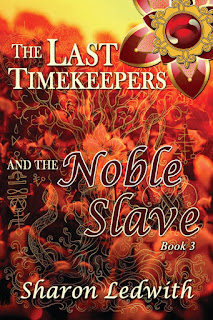
Visions of Scarlett O’Hara’s Tara from the movie Gone with the Wind or the famous Oak Alley Plantation sweep through ones’ mind when conjuring up those antebellum period plantations of the deep south for some. However, for the black race and people of color, plantation life in the 1700s and 1800s was a constant struggle just to stay alive. In The Last Timekeepers and the Noble Slave, the third installment of The Last Timekeepers time travel adventure series, eleven-year-old protagonist Drake Bailey must confront not only his demons, but the terrible oppression and cruelty against his race in antebellum Georgia.

When I researched these grand Southern homes for my novel, I found a few myths in this mired past. In movies, plantations were often depicted as ‘mansions’ with fluted columns and a broad porch; massive trees with their drooping limbs lining circular driveways, and finely dressed men and women parading their wealth for all to see. Um, no. There were a few plantations which fit this description, but these were the exceptions. Most plantation owners lived modestly and some even poorly. The overwhelming majority of slaveholders held less than twenty slaves. Yet, even if a man only held one or two slaves, he had considerably more status in southern society than a man who held no slaves. Status was everything to the South’s white population, and the more slaves a man owned, the more respected he was.

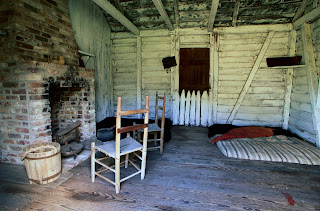
The plantation was a world in itself. I created the fictional Taylor Plantation situated near Athens Georgia, close to where my time traveling characters would land. Trying to keep the grounds as authentic as I could, the plantation was comprised of the slave owner’s house (the Taylors) which was called the ‘big house’, the line of single-room cabins dubbed ‘slave row’ where slaves called ‘home’, and nearby loomed the overseer’s house. Scattered about this plantation were various barns and sheds where animals, tools, and the harvested crops were stored. Surrounding everything were cotton fields and woods, and situated in the back of the property lurked the slave cemetery by a winding creek.

Interior of slave quarters
Curious on how plantations came to be? In the early 17th century, when the British colonized what
would later become the United States of America, the crown offered large plots of land to settlers as an incentive for them to journey to a strange and harsh new world. Many settlers who took the deal combined their properties into larger settlements—in the South, these eventually became plantations. As these landowners needed immense manpower to maintain the plantations, they turned to slavery, importing captured peoples from Africa as forced laborers.

Plantations operated relatively unfettered in the American South for more than 250 years; the Northern states, however, had all abolished slavery by 1804. Despite Congress banning the African slave trade in 1808, the domestic slave trade in the South continued until the ratification of the 13th Amendment in 1865, which banned slavery outright.

During Reconstruction (post-Civil War years), the plantation system collapsed. While some plantations were destroyed, many were subdivided, with both black and white farmers leasing these smaller plots as sharecroppers (who would give a portion of their harvest to the landowner as ‘rent’) or tenant farmers (who paid rent). These farming practices continued through the mid-20th century until the Great Depression and advancements in farming technology got rid of traditional plantations for good.   

Many people descended from African American slaves consider plantations to be the American version of Auschwitz. They’re not wrong. Filled with echoes of death and despair, Southern plantations—many of which are in disrepair and decay—are places where slavery made the romanticized southern lifestyle possible, and continue to carry their dark legacy to this day.

Here’s a snippet of what to expect in the third installment of The Last Timekeepers available for purchase on all your online bookstores…


True freedom happens only when you choose to be free.

Eleven-year-old Drake Bailey is an analytical thinker and the genius of the Timekeeper crew. However, no logic or mathematical acumen can change the color of his skin, or prepare him for this third Timekeeper mission in antebellum Georgia. To survive, Drake must learn to play the role of a plantation slave and when confronted with the brutality, hatred, and racism of the deep south, he’ll have to strategically keep one move ahead of his sadistic captors to ensure his lineage continues.

In a dark world of Voodoo, zombies, and ritualistic sacrifice, the Timekeepers must ensure a royal bloodline survives. Can Drake remove both literal and figurative chains to save both himself and a devout slave girl from a terrible fate? If he can’t summon the necessary courage, humanity could stand to lose one of its greatest leaders.

Amazon Buy Link

Sunday, 22 November 2020

White Chocolate: a Sweet Faux Pas by Anne Montgomery...


I love chocolate, which does not make me special. Americans consume roughly 18% of the world's chocolate stash, spending over $18 billion annually on the rich, creamy confection. 

 As a child, my mother fretted constantly about my waistline and hid sweets from me. In retaliation, I'd scour my dad's Brooks Brothers suit-coat pockets for change and trundle through the woods to Ben's Diner, which had a long, glorious rack of candy. Ben, a big man with a giant stomach encased in a white apron, never questioned my daily haul of candy bars - which were big suckers back then. 

I'd sit by the brook with my collie Betsy and eat that candy - Snickers, Milky Way, Baby Ruth, Chunky, 100 Grand Bar, M&Ms, Heath Bar - every day. 

My mom, exasperated by my girth, would defend herself to strangers. "It's not my fault," she'd tell people when she thought they were staring at me. "I feed her baked fish and salad with no dressing." 

 I always wanted to say, "I'm fat, Mom, not deaf. I can hear what you're saying." But I never did.
The point is, I love chocolate, which brings me to the abomination: white chocolate. 

I realize that some people like that creepy colorless confection. I also know that, lately, fancy chocolatiers have been experimenting with it in an effort to make it more hip. Still, the fact that white chocolate includes cocoa butter, which is derived from cocoa beans, does not make the substance chocolate. One needs cocoa solids to make actual chocolate. (Yes, I know the FDA claims white chocolate made to their standards is considered chocolate, but I'm not having it.) 

White chocolate was first unveiled in the 1930s, a product of the Nestlé company in Switzerland. The theory goes that the substance was invented to utilize excess cocoa butter, but no one is really sure. 

The Maya, who were the first people to cultivate cacao trees, probably would be stupefied to learn that their prized chocolate - the beans of which they used as a form of currency - is now offered in this pale, unrecognizable form. 
 

And, even worse, those trendy chocolatiers are doing unspeakable things to this white sweet. You can now purchase organic kale with mustard mixed into your white chocolate. And salted almonds with broccoli. Clearly, there are maniacal minds at work here. Confectioners who make Gene Wilder's Willy Wonka appear quite sane. 


So, what are we to do with this sweet faux pas? Despite my misgivings, I don't mind a bit of white as a decoration. After all, it's pretty. But as a real chocolate substitute? Never! 

 So give me a dab of white chocolate, if you must, but please ... hold the broccoli. 


Here’s a little from my latest women's fiction book. I hope you enjoy it.

A woman flees an abusive husband and finds hope in the wilds of the Arizona desert.

Rebecca Quinn escapes her controlling husband and, with nowhere else to go, hops the red-eye to Arizona. There, Gaby Strand - her aunt’s college roommate - gives her shelter at the Salt River Inn, a 1930’s guesthouse located in the wildly beautiful Tonto National Forest.

Becca struggles with post-traumatic stress, but is enthralled by the splendor and fragility of the Sonoran Desert. The once aspiring artist meets Noah Tanner, a cattle rancher and beekeeper, Oscar Billingsley, a retired psychiatrist and avid birder, and a blacksmith named Walt. Thanks to her new friends and a small band of wild horses, Becca adjusts to life in the desert and rekindles her love of art.

Then, Becca’s husband tracks her down, forcing her to summon all her strength. But can she finally stop running away?

Amazon Buy Links

Anne Montgomery has worked as a television sportscaster, newspaper and magazine writer, teacher, amateur baseball umpire, and high school football referee. She worked at WRBL‐TV in Columbus, Georgia, WROC‐TV in Rochester, New York, KTSP‐TV in Phoenix, Arizona, ESPN in Bristol, Connecticut, where she anchored the Emmy and ACE award‐winning SportsCenter, and ASPN-TV as the studio host for the NBA’s Phoenix Suns. Montgomery has been a freelance and staff writer for six publications, writing sports, features, movie reviews, and archeological pieces.

When she can, Anne indulges in her passions: rock collecting, scuba diving, football refereeing, and playing her guitar.

Learn more about Anne Montgomery on her website and Wikipedia. Stay connected on Facebook, Linkedin, and Twitter.

Monday, 6 July 2020

Guest Post: History - the Most Important Timeline of All by Carol Browne...

Photo by Gustavo Fring from Pexels
Covid-19 is a game-changer in so many ways. It is making people rethink their lives, their jobs, their relationships, their aspirations, even their diets and the way they treat the planet they live on. The virus landed like a bolt out of the blue, illuminating the dark places in our lives and altering our perceptions. Many things that were thought of as important are now shown to be superficial and shallow. The way we structure our days has also come under intense scrutiny. Two areas of human activity in particular are undergoing a much-needed overhaul, and they are employment and education. People who can work from home during the lockdown can see the benefits of making this permanent. Meanwhile, many parents who have been home schooling their children are wondering if they should continue with it.

I was discussing this with a close friend of mine who has been working from home and is considering home schooling. She was concerned about peer pressure at the school one of her children attends and how it has had a detrimental effect on the child’s self-esteem. It is always hard to be different. It’s equally hard for an adult to do something different from what is considered normal. We often stick with the status quo for fear of being criticised. But, as the memes insist, the virus has shown us that normal wasn’t working. It’s time to create a new paradigm for living and my friend has seen the beneficial effects that home schooling has already had on both her children.

But this isn’t a blog about home schooling! When my friend and I were discussing different ways of educating her children, I reminded her of how we used to be taught history. We started as far back as the dinosaurs and moved forwards incrementally to the present day. As a result, I have had a mental image in my mind of every century down the ages with major events recorded on this timeline of history, so that I know where I am in the great scheme of things. I can see how mankind got to where it is today. It is like belonging to the timeline of humanity where everything makes sense, even the bad things, because wars have causes that can be traced back and great transitions, like the one we are experiencing now, can be anchored in time and better understood.

Do children still learn history this way? I meet so many young people who have no idea what happened before World War II (and don’t see the socio-economic and political factors that brought about that global conflict). Yes, they know about the Romans and perhaps the Ancient Egyptians but can’t pin them down to a particular era.

Photo by Fauxels from Pexels
And here in the UK how many of the people who are so proud to be British know anything about the history of the British Isles? Why do we use the words British and English; what’s the difference? We were a nation of immigrants long before the Roman occupation, during which time we really were British but not English. If everyone understood that we have all migrated here from other countries, would we rethink our current attitude to immigration? And if we knew more about our imperialist past with its horrors of slavery and oppression, would we see how racism developed and be better able to reject it?

Everything that happens is a lesson and the lessons of history will keep repeating on the timeline until we decide to take a stand and say no more. Only by understanding the timeline of the past can we see the need for change in the present. Allowing children to grow up without reference points or connections to ancestral knowledge, is not giving them freedom. It leaves them adrift in the modern world not knowing why things are the way they are. To teach children the lessons of history is to give them the tools they need to make their world a better place and create a brighter future.

History is important. In my book Being Krystyna – A Story of Survival in WWII I showed how intolerance for other people’s differences can lead to persecution and conflict. Krystyna herself always feared the Nazis would return, and looking at world events today I think she was right. One way to stop the resurgence of such evil is to make sure that the lessons of history are never forgotten. But first we have to learn them.

Here is a brief introduction to my book. Thank you for reading it.

It’s 2012, the year of the London Olympics, and for young Polish immigrant Agnieszka, visiting fellow countrywoman Krystyna in a Peterborough care home is a simple act of kindness. However, the meeting proves to be the beginning of a life-changing experience.

Krystyna’s stories about the past are not memories of the good old days but recollections of war-ravaged Europe: The Warsaw Ghetto, Pawiak Prison, Ravensbrück Concentration Camp, and the death march to freedom.

The losses and ordeals Krystyna suffered and what she had to do to survive, these are horrors Agnieszka must confront when she volunteers to be Krystyna’s biographer.

Will Agnieszka find a way to accomplish her task, and, in this harrowing story of survival, what is the message for us today?

Buy Links

Born in Stafford in the UK, Carol Browne was raised in Crewe, Cheshire, which she thinks of as her home town. Interested in reading and writing at an early age, Carol pursued her passions at Nottingham University and was awarded an honours degree in English Language and Literature. Now living and working in the Cambridgeshire countryside, Carol usually writes fiction and is a contracted author at Burning Willow Press. Being Krystyna, published by Dilliebooks on 11th November, 2016, is her first non-fiction book.

Stay connected with Carol on her website and blog, Facebook, and Twitter.

Monday, 6 January 2020

Guest Post: Latin - the Dead Language that Speaks to Us Today by Carol Browne...

I know I was lucky when it came to education. Not only did I live in the UK at a time before austerity when the state paid for all our equipment, I also got to attend a grammar school. That meant I studied Latin for about the first four years I was there. At the time I didn’t see the relevance; none of my contemporaries did. It was a dead language confined to history. Something for academics and librarians and archaeologists. A difficult study for an English brain not used to complicated conjunctions and declensions. The concept that nouns had to be classified into gender was bizarre. All the different word endings that had to agree with each other made my head reel. It seemed Latin was something you did to get a qualification—and I did. I achieved what in those days was called an ‘O’ Level. So, job done. Stick it on the CV with all the others.

Image by Desi Maxwell from Pixabay
It was after I left school that I learned to love Latin and appreciate its value as a linguistic tool. More than that, I understood its historical significance, how it helped to shape the modern world we have today. How many languages have Latinate words as part of their lexicon? How many countries, corporations and institutions use Latin mottos? I’m thinking of a famous one here, E Pluribus Unum (Out of many, one) which appears on the Great Seal of the United States of America.

Latin invaded Britain along with the Romans in the first century and it was clearly determined to take root as part of the language of the indigenous people because it became the language of the church for centuries. In 1066, when the Norman French invaded Britain, their Latinate tongue became the dominant language and married itself without ceremony to that spoken by the oppressed Anglo- Saxons. In this way, Latin moved up to another level and its words formed a large part of what was to become what we now know as English. People wonder why in English there are so many different words for the same thing but the richness of the language is a result of having input from so many other languages brought to Britain by a variety of invaders.

Image by Photos for You from Pixabay
So from a living language spoken by the Romans, to an elitist language used by the church and the legislature, it evolved in many ways, even giving scientific names to plants, animals, diseases and body parts! And now it is supposedly a dead language because no-one speaks it anymore except for academics and historians. And yet how can you call it dead when it is so widely used?

As a writer Latin isn’t dead to me. I can call upon my knowledge of Latin to help me work out the meaning of many words in use today. If I encounter an unfamiliar word, as long as it has had some truck with Latin during its evolution, I am likely to be able to recognise some part of it that will facilitate my understanding. Latin prefixes are extremely helpful: ex, inter, trans, sub, contra, for example. These are already pointing you in a certain direction. A submarine is obviously going to operate under the sea rather than above it! (And marine is also of Latin origin—‘mare’, sea.) Latin has also helped me translate words in other Latinate languages like Italian and Spanish, even though I’m not that acquainted with them.

Latin is timeless, as familiar in Shakespeare’s plays as in Hollywood movies. It has expanded its influence into popular culture without most people giving it a second thought—where would Hogwarts professors be without their Latin-inspired incantations? In the Marvel universe, what would Magneto be called without that ancient Roman language? (L. ‘magnes’?) All those horror films where the bad guys try to summon demons wouldn’t be half so dramatic if they didn’t use Latin to do it; likewise, exorcisms sound much more impressive in Latin. It is, I have come to realise, a rather beautiful language.

Versatile too. You can have fun with Latin. In The Handmaid’s Tale, ‘nolite te bastardes carborundorum’ (Don’t let the bastards grind you down) is grammatically incorrect Latin with some made-up words and was a joke Margaret Attwood remembered from school, but it struck a chord with her audience and people actually have it tattooed on their wrists!

Latin isn’t dead. It never really went away. Those ancient Romans gave us the gift that keeps on giving; even our planets are named after their gods and goddesses. Latin went global long before that concept even existed.

The question must be, did we absorb Latin or did Latin absorb us! Whatever the answer, Latin is here to stay.

Here is a little from my latest release for your reading pleasure. Yes, a little Latin has worked its way into this psychological thriller.

Gillian Roth finds herself in middle age, living alone, working in a dull job, with few friends and little excitement in her life. So far, so ordinary.

But Gillian has one extraordinary problem. Her house is full of other people… people who don’t exist. Or do they?

As her surreal home life spirals out of control, Gillian determines to find out the truth and undertakes an investigation into the nature of reality itself.

Will this provide an answer to her dilemma, or will the escalating situation push her over the edge before she has worked out what is really going on?

BLURB
Thursday, 26th March, 2015.

My house is filled with people who don’t exist.

They have no substance. They are neither alive nor dead. They aren’t hosts or spirits. They aren’t in any way shape or form here, but I can see them, and now I need to make a record of how they came to be under my roof.

Why now? Why today? Because we line in strange times, and today is one of the strangest days this year; this is the day that Richard III, the last Plantagenet king of England, was interred in Leicester Cathedral, with all due ceremony, 530 years after he was slain at the Battle of Bosworth in 1485. How surreal is that? I watched the highlights on Channel 4 earlier. A couple of my house guests sat with me and together we marveled at the event. They did Richard proud, no doubt of that.

I left them to it after a while and came up here to my bedroom to start writing a diary: this diary.

Life feels unreal today, as if time has looped back onto photo albums. The house clearly passed must itself and everything is happening now. And if I can set my thoughts down on paper, perhaps I can make sense of everything, make it all real somehow.

Where did it start, this thing that has happened to me? A couple of years ago? I can’t say when. It evolved without my conscious input. The existence of my house guests was a fact long before I began to wonder at it. I do wonder at it now and I know I must keep track of what’s happening before I lose myself in this crowd of imaginary beings.

At first there was only a few of them, and I observed their doings without much concern. I watched them snooping around the place, choosing the most comfortable chairs to sit in, leaning against the furniture, inspecting the bookcases, checking the kitchen utensils, and peering into my photo albums. The house clearly passed muster and they stayed. In time, they knew me down to the marrow. I have never known them as well as they know me. They have an air of mystery, as though they have a life outside my house they will never divulge. Even so, I felt I was safe with them and I could tell them my problems. Tell them what no-one else must ever hear. And so these shades thickened, quickened; their personalities accumulated depth and solidity, as though they were skeletons clothing themselves in flesh.

I no longer came home to a cold, empty house, but to a sanctuary where attentive friends awaited my return. I was embraced by their jovial welcome when I stepped through the door. I never knew which of them would be there, but one or two at least would always be waiting to greet me, anxious to hear about my day and make me feel wanted, and for a while I could forget the problems I have at work (even the one that bothers me the most). Since then I have felt a subtle change.

But I’m getting ahead of myself. I really need this to be a faithful account of the entire situation from start to finish, so I have to try to work out how it all began, even if I’m not sure when.

If I cast my mind back, it floats like a lantern through a city cloaked in fog. I must try to isolate the shadowy figures that flit up at me out of the murk. So, let’s begin with the friend I remember first. I was cooking my evening meal. My mind wandered. I remember feeling sad. And there she stood, at my right elbow, peering into the saucepan.

“Watch you don’t burn that,” she said.

I don’t have names for my imaginary friends, just titles, so I call her Kitchen Girl. She’s dark-haired with porcelain skin, and she’s tall and voluptuous. The sort of woman I’d like to be except I’m small with red hair and a ruddy complexion, and I need chicken fillets to convince people I’m female. I suppose Kitchen Girl is rather daunting, with those fierce blue eyes and no-nonsense approach to everything. I can stand up to her though. I use humour as my weapon of choice and she appreciates wit and banter. I’d like it if she didn’t nag so much, if I’m honest (“Use less salt... keep stirring... is that all you’re going to eat?”) but, criticism aside, I know she’ll compliment me on the finished product as it lies uneaten between us on the table. Long conversations back and forth have been played out while the meals go cold on their plates. Fried eggs congeal and go waxen. Ice cream melts into a tepid sludge. Sandwiches curl up with embarrassment to be so spurned. You know how it is when you get gossiping. Someone wants to talk to me and that’s better than food.

And sometimes, it’s curious, but it’s Kitchen Girl who cooks the food and serves it to me like a waitress. She likes to surprise me with new dishes.

I have no idea how this happens.

Nor why she never leaves the kitchen. But I wish she’d do the washing up now and then.

Amazon Buy Links e-Book - Paperback


Born in Stafford in the UK, Carol Browne was raised in Crewe, Cheshire, which she thinks of as her home town. Interested in reading and writing at an early age, Carol pursued her passions at Nottingham University and was awarded an honours degree in English Language and Literature. Now living and working in the Cambridgeshire countryside, Carol writes both fiction and non-fiction.

Stay connected with Carol on her website and blog, Facebook, and Twitter.