Showing posts with label slavery. Show all posts

Sunday, 30 January 2022

Southern Plantations’ Dark Legacy…

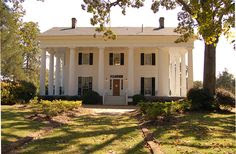
Antebellum-style Plantation House

Visions of Scarlett O’Hara’s Tara from the movie Gone with the Wind or the famous Oak Alley Plantation sweep through ones’ mind when conjuring up those antebellum period plantations of the deep south for some. However, for the black race and people of color, plantation life in the 1700s and 1800s was a constant struggle just to stay alive. In The Last Timekeepers and the Noble Slave, the third installment of The Last Timekeepers time travel adventure series, eleven-year-old protagonist Drake Bailey must confront not only his demons, but the terrible oppression and cruelty against his race in antebellum Georgia.

When I researched these grand Southern homes for my novel, I found a few myths in this mired past. In movies, plantations were often depicted as ‘mansions’ with fluted columns and a broad porch; massive trees with their drooping limbs lining circular driveways, and finely dressed men and women parading their wealth for all to see. Um, no. There were a few plantations which fit this description, but these were the exceptions. Most plantation owners lived modestly and some even poorly. The overwhelming majority of slaveholders held less than twenty slaves. Yet, even if a man only held one or two slaves, he had considerably more status in southern society than a man who held no slaves. Status was everything to the South’s white population, and the more slaves a man owned, the more respected he was.

The plantation was a world in itself. I created the fictional Taylor Plantation situated near Athens Georgia, close to where my time traveling characters would land. Trying to keep the grounds as authentic as I could, the plantation was comprised of the slave owner’s house (the Taylors) which was called the ‘big house’, the line of single-room cabins dubbed ‘slave row’ where slaves called ‘home’, and nearby loomed the overseer’s house. Scattered about this plantation were various barns and sheds where animals, tools, and the harvested crops were stored. Surrounding everything were cotton fields and woods, and situated in the back of the property lurked the slave cemetery by a winding creek.
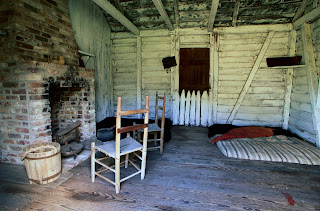
Interior of slave quarters
Curious on how plantations came to be? In the early 17th century, when the British colonized what
would later become the United States of America, the crown offered large plots of land to settlers as an incentive for them to journey to a strange and harsh new world. Many settlers who took the deal combined their properties into larger settlements—in the South, these eventually became plantations. As these landowners needed immense manpower to maintain the plantations, they turned to slavery, importing captured peoples from Africa as forced laborers.

Plantations operated relatively unfettered in the American South for more than 250 years; the Northern states, however, had all abolished slavery by 1804. Despite Congress banning the African slave trade in 1808, the domestic slave trade in the South continued until the ratification of the 13th Amendment in 1865, which banned slavery outright.

During Reconstruction (post-Civil War years), the plantation system collapsed. While some plantations were destroyed, many were subdivided, with both black and white farmers leasing these smaller plots as sharecroppers (who would give a portion of their harvest to the landowner as ‘rent’) or tenant farmers (who paid rent). These farming practices continued through the mid-20th century until the Great Depression and advancements in farming technology got rid of traditional plantations for good.   

Many people descended from African American slaves consider plantations to be the American version of Auschwitz. They’re not wrong. Filled with echoes of death and despair, Southern plantations—many of which are in disrepair and decay—are places where slavery made the romanticized southern lifestyle possible, and continue to carry their dark legacy to this day.

Here’s a snippet of what to expect in the third installment of The Last Timekeepers available for purchase on all your online bookstores…
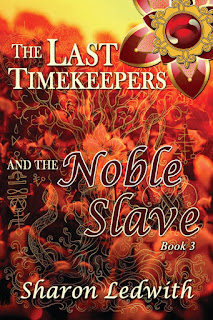

True freedom happens only when you choose to be free.

Eleven-year-old Drake Bailey is an analytical thinker and the genius of the Timekeeper crew. However, no logic or mathematical acumen can change the color of his skin, or prepare him for this third Timekeeper mission in antebellum Georgia. To survive, Drake must learn to play the role of a plantation slave and when confronted with the brutality, hatred, and racism of the deep south, he’ll have to strategically keep one move ahead of his sadistic captors to ensure his lineage continues.

In a dark world of Voodoo, zombies, and ritualistic sacrifice, the Timekeepers must ensure a royal bloodline survives. Can Drake remove both literal and figurative chains to save both himself and a devout slave girl from a terrible fate? If he can’t summon the necessary courage, humanity could stand to lose one of its greatest leaders.

Amazon Buy Link

Sunday, 21 November 2021

Need help? Call on a Loa or Orisha…


Depending on your culture or beliefs, more and more people are being drawn to their pre-Christian ancestral ways. Modern African American, Afro-Caribbean, South American, and many other magical people feel called to work with the Orishas or Loa. In The Last Timekeepers and the Noble Slave, the third installment of my young adult time travel adventure series, I included a scene where my character (Henri) practices Voodoo sorcery. During his ceremony he summons an evil Loa Voodoo spirit by the name of Kalfu. To offset this, I added another scene later in the book where my point-of-view character, Drake Bailey is forced to conjure the Orisha, Shango, who is one of the Seven African Powers.

Loa are the Voodoo spirits called upon by practitioners in order to make a request, whether it’s to improve one’s romantic life or heal a loved one’s sickness. Since each Loa is responsible for a different aspect of life, there are hundreds of these spirits and each has their own veve symbol (religious symbol used in different branches of Voodoo) used to invoke them. Loa legends like Papa Legba (gatekeeper to the Loa world) and Baron Samedi (keeper of the spirit world and ruler of the dead), or creations based on them, are often used as characters in movies, comics, and television. Unfortunately, these recreations are usually caricatures and often give Voodoo the reputation of being creepy and evil. Misunderstood facts about Loa sometimes make the things Loa can do seem dark and scary, but there are many Loa spirits who are benevolent. There are those who represent love, romance, and fertility in addition to death and war.

Kalfu
Kalfu is definitely not a warm and fuzzy Loa. He also happens to be the twin brother of Papa Legba,
and helps control the crossroads between the dead and the living as well. However, Kalfu is considered to be more of an evil twin and is known to only let bad spirits cross over. While Papa Legba’s righteousness caused him to become old and frail, Kalfu stayed young and strong. Since balance is needed in the world, Kalfu is a very important Loa and is necessary to compliment his brother. Kalfu’s power with black magic leads people who desire injustice, misfortune, and destruction to call upon him. Despite being a feared Loa, he is also well respected thanks to his power.

The Orishas—particularly the Seven African Powers—are a group of spirits originating from Yorubaland, which is a region in Africa spanning Nigeria, Benin, and Togo. Some people liken the Orishas to gods and goddesses. They are similar but not quite the same. Put simply, Orishas are spirit beings who may be anywhere from intangible to fully manifest in the flesh. They represent facets of God, the Supreme Deity—manifestation of God’s many faces and natures, if you like. Each Orisha has an associated color, an appropriate offering, and other associations.

Shango

Shango is the most beloved of all Orishas. He is the immensely powerful Lord of Thunder, Lightning, and Fire. His colors are red and white, and his loves dancing and music. Lover boy supreme, Shango epitomizes virility, male beauty, and the procreative energy. He is invoked for courage and justice, and in Yoruba cosmology, lightning is understood as an instrument of divine justice, retribution, and protection. As the wielder of lightning, Shango provides victory over enemies and protects from all evil by breaking hexes, curses, and evil spells. With a bio like that, it’s no wonder Shango is the most popular!

It should go without saying that if you plan to invoke and work with the Orishas or Loa (whether Shango or Kalfu or others), you should approach them with respect and reverence. Understand the culture and people from whence these magical beings came. These spirits, the Orishas and Loa, were brought to the Americas on the backs of the enslaved Africans. They’ve survived because of the culture. They’ll continue to survive through those who need a little extra help.

Looking for help choosing your next read or a gift for the reader in your family? Here's a glimpse of The Last Timekeepers and the Noble Slave, Book 3 in my young adult time travel adventure series...

True freedom happens only when you choose to be free.

Eleven-year-old Drake Bailey is an analytical thinker and the genius of the Timekeeper crew. However, no logic or mathematical acumen can change the color of his skin, or prepare him for this third Timekeeper mission in antebellum Georgia. To survive, Drake must learn to play the role of a plantation slave and when confronted with the brutality, hatred, and racism of the deep south, he’ll have to strategically keep one move ahead of his sadistic captors to ensure his lineage continues.

In a dark world of Voodoo, zombies, and ritualistic sacrifice, the Timekeepers must ensure a royal bloodline survives. Can Drake remove both literal and figurative chains to save both himself and a devout slave girl from a terrible fate? If he can’t summon the necessary courage, humanity could stand to lose one of its greatest leaders.

Amazon Buy Link

Sunday, 17 October 2021

Voodoo verses Obeah…


Voodoo is the product of the slave trade (principally in the Spanish and French colonies in the Caribbean), and derives from vodu, meaning spirit or deity in the Fon language of Dahomey, now part of Nigeria. Creole slave masters in the New World translated the word into vaudau, and eventually became known as voudou, voudoun, vodoun, voodoo, and hoodoo. Whites forbade their slaves to practice their Voodoo religion on pain of torture and death. Any slave found possessing a fetish (sacred objects such as dolls, carved images, animal teeth, claws or bones) was to be imprisoned, hanged, or flayed alive. Seems like the equivalent of the Spanish Inquisition, don’t you think?

To save black souls, the masters baptized the slaves as Catholics. Tribal deities took on the forms of Catholic saints, and fetishes were replaced by Catholic statues, candles, and holy relics. Voodoo therefore consists of both traditional West African beliefs blended with local variations, and also of various magical techniques employed to achieve certain ends, including the descent of the gods into individual worshippers to give oracles and to provide protection. These magical techniques are known as Obeah.

There are many theories about the origins of Obeah, even the word itself. There are many words in
many West African languages that have ‘obi’ or ‘obea’ in theme that are connected to mysticism. Since many Igbo people were taken to the West Indies as slaves though, the term most likely originated from the Igbo word ‘obia’ which means working as a healer or doctor. Some call it sorcery or witchcraft, however unlike some western forms of witchcraft, it also does not come from an attitude of the Spirits serving the person, but the person serving the Spirits. Obeah practitioners would consider it unthinkable to summon a demon and give it orders as if it was obligated to obey. Like any Voodoo practitioner, if they’re calling on a Spirit, they follow the proper procedure, approach with humility, and do not show up empty handed.

In the third instalment of The Last Timekeepers time travel adventure series, The Last Timekeepersand the Noble Slave, my character Henri is a mulatto slave driver who’s originally from Louisiana, and practices Voodoo. Louisiana Voodoo (a.k.a. New Orleans Voodoo) developed within the French, Spanish, and Creole population of the U.S. state of Louisiana. It is often confused with—but not completely separable from—Haitian Voodoo and southern Hoodoo (folk magic). Henri’s practices differ from Voodoo in the emphasis upon his use of Gris-Gris (charm bags filled with magical powders, herbs, bones, feathers, and so on) and Voodoo dolls to control and manipulate the plantation slaves.

In contrast, another character—a slave from Jamaica named Eilish, practices Obeah. She embodies what it is to be ‘Obeah’ and believes no human is stronger than Nature itself, and that every action has consequences. Her biggest belief? Don’t do bad things to people. That’s it. To the Obeah, when you do bad things to people, you put a wound on your soul. Even in the scientific sense, harming others damages you psychologically. So the more wrong you do to others, the more vulnerable you become to the dark forces of Nature.


Speaking of dark forces, those who worship Voodoo may not all practice black magic, but darker aspects of Voodoo do exist. A practitioner known as a bokor is more involved in sorcery than healing, and their greatest fear is not a death curse but zombification. Now that’s what I’d call some badass karma! In the end, if you do your best to make up for your wrongs, you will be blessed in other ways. You will at least have peace and be stronger for what you have learned.

Monday, 20 January 2020

The Escape Network of the 1800s: The Underground Railroad…

Amherstburg Freedom Museum

Since today falls on Martin Luther King Jr. Day around the time of writing this post, I thought it fitting to do a piece on the Underground Railroad. I’m actually fortunate enough to live in an area in Ontario, Canada that played a large role in helping slaves escape the horrors of plantation life in America’s southern states during the 1800s. It’s even more of a blessing that I live near the Amherstburg Freedom Museum, where the museum’s mandate states, “To tell the stories of Amherstburg’s role in the Underground Railroad, and African-Canadians’ journey and contributions to Canada and the region”. Believe it or not, at one time this area was a chief entry point into Canada for those escaping slavery.
While doing research and outlining for the next book in my young adult time travel series, The Last Timekeepers and the Noble Slave, I found a lot of interesting tidbits and facts about the Underground Railroad, and where the name came from. If you don’t know the history, this ‘escape network’ was not literally underground nor a railroad. It was figuratively “underground” in the sense of being an underground resistance. It was known as a “railroad” by way of the use of rail terminology in the code. Pretty darn clandestine, don’t you think?
The Underground Railroad consisted of meeting points, secret routes, transportation, and safe houses, and personal assistance provided by abolitionist sympathizers. The resting spots where the runaways could sleep and eat were given the code names “stations” and “depots,” which were held by “station masters”. “Stockholders” gave money or supplies for assistance. Participants generally organized in small, independent groups; this helped to maintain secrecy because individuals knew some connecting “stations” along the route but knew few details of their immediate area. Escaped slaves would move north (usually following the north star, or when overcast, the river) along the route from one station to the next. “Conductors” on the railroad came from various backgrounds and included free-born blacks, white abolitionists, former slaves (either escaped or manumitted), and Native Americans. Church clergy and congregations often played a role, especially the Quakers, as well as certain sects of mainstream denominations such as branches of the Methodist church and American Baptists. Without the presence and support of free black residents, there would have been almost no chance for fugitive slaves to pass into freedom unmolested.
Harriet Tubman
In 2019 the movie Harriet was released, telling the story of one of the most famous conductors, slave-turned-abolitionist Harriet Tubman. She was a true hero in every sense of the word, who would give every drop of her blood, and wouldn’t stop freeing her people until “this monster called slavery” was dead. Crowned “Black Moses”, Harriet, with a strong and unwavering faith in God and the help of free blacks and sympathetic whites, managed to successfully lead more than three hundred slaves, including her family, to freedom. Now, that’s some track record!
If you get a chance, please check out the Amherstburg Freedom Museum’s page called ‘Sharing Our Stories’, and watch some of the videos. I guarantee that you’ll rethink the meaning of FREEDOM, and what it meant to those who escaped the evils of slavery during the 1800s, and those who chase freedom even now. I’ll leave you with this quote from one of the narrators sharing her family’s story, “You need to know who you are and of the sacrifices made for your freedom”. Amen to that.
So what does freedom mean to you personally? Have you ever thought of the sacrifices made by your ancestors that has led you to living the life you are now? Would love to read your comments. Cheers, and thank you for reading my blog.

Monday, 21 January 2019

Removing the Chains…


Today marks Martin Luther King Jr. Day in the USA, which promotes equal rights for all Americans, regardless of their backgrounds. So, I thought it would be appropriate to honor this civil rights leader’s memory, and those who have sacrificed and struggled before him, by sharing one of the most powerful books I’ve recently read, with you. While researching for the next installment of The Last Timekeepers series, entitled The Last Timekeepers and the Noble Slave, I came upon this non-fiction gem, To Be A Slave. Released in 1968, To Be A Slave was actually written for middle grade children, and has garnered many awards including a Newbery Honor. Authored by Julius Lester and illustrated by Tom Feelings, the book explores what it was like to be a slave. It includes many personal accounts of former slaves, accompanied by Lester’s historical commentary, and Feelings’ powerful and muted drawings.

I found that To Be a Slave fills a void in the documentation of American history by providing a concrete illustration of the culture and history of blacks in the United States. It contained a treasure trove of research material I was able to glean for my book, and I’m humbled to have received a glimpse into the lives of slaves through Lester’s thorough research. The book focuses on the plight of blacks: their brutal capture in Africa, their confined passage to America in slave ships, and their subsequent servitude. Rather than offering a dry summary of these events, Lester brings history to life, presenting the testimony of former slaves (including Solomon Northup of Twelve Years a Slave) who describe their experiences in visceral detail. Because most slaves were illiterate, their stories were passed along orally, but most written historical accounts of slavery ignore this oral tradition, focusing instead on how slavery as an institution affected the white, mainstream society. Hence, Lester fills a historical gap by providing a black perspective on the same situation.

In my opinion, To Be A Slave (along with Anne Frank: The Diary of a Young Girl) should be part of every school’s curriculum to educate our youth on what it’s like to walk in the shoes of those who lived before them. It’s also like having a time travel portal in the classroom. Of course, slavery still exists throughout the world, but humanity’s view has changed in leaps and bounds since the 1700s. We still have a long way to go, but we’re making headway and removing those chains, one link at a time.

If you’re interested in Julius Lester’s phenomenal book, To Be A Slave, you can check it out HERE. I’ll leave you with a taste of this classic book that forever pulled me into Lester’s shoes:

“It was the late forties. I was not yet ten years old. One day there came in the mail a letter addressed to my father in which a company promised—in big and bold letters—to research the Lester family tree and send us a copy of our family coat of arms. I was excited, but when I saw my father fold the letter as if to discard it, I asked anxiously, ‘Don’t you want to know our family history?’

He laughed dryly. ‘I don’t need to pay anybody to tell me about where we come from. Our family tree ends in a bill of sale. Lester is the name of the family that owned us.’
His words were one of the defining moments of my life.”