Showing posts with label The Exile of Elindel. Show all posts

Sunday, 18 January 2026

Guest Post: The Curse of Continuity by Epic Fantasy Author Carol Browne...


You’ll hear writers complain about the number of typos that get missed during the editing and proofreading processes, so their work is published with errors it is too late to fix. This is something that happens to even the most well-known authors, regardless of what publisher they use.

As a proofreader who is also an author, I have seen typos in my own published work and have no idea how I missed them. There is some kind of brain glitch that sees what it expects to see, hence, for example, ‘to’ becomes ‘do’, and the meaning of an entire sentence is lost. We just have to hope that readers suffer from the same glitch or like our work enough to overlook the mistakes.

Proofreading errors are bad enough, but far worse are errors in continuity and these may be harder to spot. For example, a character may sit at a table while having already done so on the previous page; someone claims to have come by bus, yet we know he left his car in the car park; the protagonist is shown into the boss’s office by a blonde secretary who is a redhead when he comes out.

I have just finished editing a book I wrote over several years. It started as three novellas which were then glued together into one novel. Revisiting old material is a challenge anyway but more so when a book has been written in sections with not enough thought to the sequence of events. Continuity errors have been a nightmare with this particular work, and chunks of the narrative had to be rewritten to iron out the inconsistencies. Proofreading errors, conversely, have been a doddle.

While storytelling is an author’s main function, there are many other factors that must be borne in mind. An author must:

1.     Create interesting, believable characters that the readers will care about

2.     Provide them with a plotline that works

3.     Weave any necessary subplots seamlessly into the narrative

4.     Be fluent and grammatically correct in the language of their choice

5.     Avoid spelling and style errors and typos

6.     Create a consistent atmosphere to suit the genre of the work

7.     Do sufficient research to support the credibility of the work

8.     Decide if certain themes, social commentaries or observations are to be included

9.     Maintain the interest of the readers throughout, regardless of their demographic, and

10  Never disappoint their readers with weak endings and plot holes.

While juggling all of the above, continuity might slide under the radar, but an author must keep track of what their characters are doing: their movements; appearance; clothes; dialogue; relationships; backstories; ages; emotions, and so on. Added to that is the need to be aware of changes in time and place.

That’s a lot of plates to keep spinning! No wonder errors creep in.

Alas, after you’ve written and submitted your book and you’re sure you’ve created perfection, you might see one of those plates smashed on the ground when a continuity error is finally discovered—but it’s too late, because your book’s been published! A case in point is the book I am currently reading. It’s well written and compelling and the author is prolific and professionally published; however, I noted that the main character asked someone if they had any kin, to be told no, only to ask that same person the same question two pages further on, again with the same response. Given all those spinning plates the author had to keep an eye on, I’d say it happens to the best of us.

Here is a brief intro to Book One of Carol's exciting trilogy.


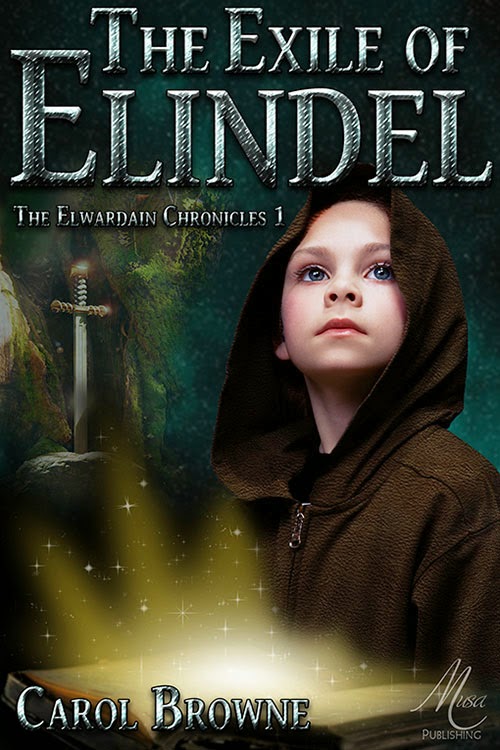
Banished from Elvendom and forced to seek refuge among the Saxons, young Elgiva faces a grim future - until she crosses paths with Godwin, a Briton enslaved by the people she must now call allies.

When a dark power rises to claim dominion over Elvendom, Elgiva and Godwin set off on a dangerous quest for the legendary Lorestone: the only thing that can stop the looming darkness. With a reluctant elf boy as their guide and a stubborn pony by their side, they must navigate the treacherous land and harness ancient magic before it’s too late.

As battle lines are drawn, Elgiva must embrace her true heritage, and Godwin must learn to wield the secret power he possesses. But can they find the Lorestone in time - or will Elvendom fall forever?

An historical fantasy adventure set in 6th century Britain, THE EXILE OF ELINDEL is the first book in Carol Browne's The Elwardain Chronicles series.

UNIVERSAL BOOK LINK


Once upon a time a little girl wrote a poem about a flower. Impressed, her teacher pinned it to the wall and, in doing so, showed the child which path to follow.

Over the years poems and stories flowed from her pen like magic from a wizard’s wand.

She is much older now, a little wiser too, and she lives in rural Cambridgeshire, where there are many trees to hug.

But inside her still is that little girl who loved Nature and discovered the magic of words.

She hopes to live happily ever after.

Stay connected with Carol on her website and blog, Facebook, and Twitter. 

Sunday, 14 September 2025

Guest Post: Dedicated to the One I Love by Epic Fantasy Author Carol Browne...

When you pick up a book, do you turn quickly to chapter one, or do you check out the dedication first? Perhaps, like me, you are intrigued to know who the book is dedicated to and why? If there is a name but no explanation for it, I always wonder what that person did to have their name immortalised in this way.

If you’re an author, your work might not necessarily be dedicated to the one you love. It could be to someone you respect, admire, or have reason to thank. Many dedications are humorous and playful and there are many examples of these online, but if you have put your passion and energy into a novel, which is a time-consuming and difficult undertaking, the dedication ought to be as weighty as the dedication you needed to write it.


In my first book, The Exile of Elindel, the dedication reads, ‘For Harry’, and readers might speculate that he is my husband, son, brother, or whatever. Actually, Harry was my dog for sixteen years and he saw me through one of the most challenging periods of my life. I don’t think The Exile of Elindel would exist had I not had Harry to give me a reason to get up every morning when everything was falling apart.

After Book 1, my ideas for a sequel solidified into a novel mainly because a close friend wanted to read it. So, Book 2, Gateway to Elvendom, was dedicated to that friend, Pat Longmuir. Even an audience of one is sufficient reason to write a book!

Books 1 and 2 called for a third book to tie up all the loose ends and bring everything to a satisfying conclusion. When it was written, I knew it should be dedicated to the memory of my niece, Bryony Cawley, who was tragically killed while only in her early 30s. She had left England while very young and lived a fearless, adventurous life in other lands, so we were apart, but I remembered a conversation we had two weeks before her death. It occurred to me at the time that she was wise beyond her years and when she died, I wondered if she had learned everything she needed to and gone on to something better. I didn’t know what to do to honour her life, but I wanted it to be recorded somewhere. Dedicating Wyrd’s End, the third book in my trilogy, to Bryony seemed to be a good way for me to pay tribute to the memory of this very special human being.

As writers we can always thank people in the acknowledgements at the end of the book, but to dedicate an entire book to someone is a unique tribute and a lasting memorial to a person who has had a significant impact on the author’s life. After all, when you have put something out into the world which will exist as long as literature does, it seems fitting to make your dedication a special gift to posterity.

Here is a brief intro to Book One of Carol's exciting trilogy.


Banished from Elvendom and forced to seek refuge among the Saxons, young Elgiva faces a grim future - until she crosses paths with Godwin, a Briton enslaved by the people she must now call allies.

When a dark power rises to claim dominion over Elvendom, Elgiva and Godwin set off on a dangerous quest for the legendary Lorestone: the only thing that can stop the looming darkness. With a reluctant elf boy as their guide and a stubborn pony by their side, they must navigate the treacherous land and harness ancient magic before it’s too late.

As battle lines are drawn, Elgiva must embrace her true heritage, and Godwin must learn to wield the secret power he possesses. But can they find the Lorestone in time - or will Elvendom fall forever?

An historical fantasy adventure set in 6th century Britain, THE EXILE OF ELINDEL is the first book in Carol Browne's The Elwardain Chronicles series.

UNIVERSAL BOOK LINK


Once upon a time a little girl wrote a poem about a flower. Impressed, her teacher pinned it to the wall and, in doing so, showed the child which path to follow.

Over the years poems and stories flowed from her pen like magic from a wizard’s wand.

She is much older now, a little wiser too, and she lives in rural Cambridgeshire, where there are many trees to hug.

But inside her still is that little girl who loved Nature and discovered the magic of words.

She hopes to live happily ever after.

Stay connected with Carol on her website and blog, Facebook, and Twitter. 

Sunday, 20 July 2025

Guest Post: KEEPING BRITAIN TIDY a Never-ending Task by Fantasy Author Carol Browne...


One of my favourite activities isn’t everyone’s cup of tea, although I wish more people would take it up. Once a week, I join a couple of neighbours and we go litter picking in our local area.

There’s an expression in the UK – “It’s like painting the Forth Bridge.” Said bridge spans the Forth Estuary in Scotland and is so big a structure that, in the days before new tech, painting it was a question of getting to the end only to have to start again at the beginning. It was a task that was never finished and so it is with litter picking.

Have humans become more thoughtless with their rubbish over the years? It does seem so. There’s more packaging on everyday purchases too, and people eat fast food on the go. When did everyone start taking bottled water and cans out with them wherever they went? What is the mentality of fly-tippers who are happy to make their rubbish someone else’s problem rather than dispose of it responsibly themselves?

Litter isn’t just unsightly; it poses serious danger to wildlife and the environment. Broken bottles can injure dogs’ paws and start forest fires. Plastic can holders trap and strangle animals – they should be cut up before disposal. Plastic that is loose in the ecosystem breaks down into tiny fragments that enter our food and water and, eventually, our bodies.

In past ages, rubbish was biodegradable. Forest floors were littered with dead leaves not crisp packets. Broken clay pottery returned to the earth from which it was made. Textiles were mended and reused. Leftover food items became compost to grow more food. There were no cigarette ends ground underfoot, no plastic bags taking flight over windswept fields.

So, my neighbours and I do our bit to clean up the detritus of modern life. We have fun doing it – you’d be surprised what we find! It’s a satisfying pastime because we can see that we’ve made a difference to our neighbourhood, and it sets a good example to others – litterally! Imagine if everyone just kept the area outside their own home litter-free, wouldn’t that be something!

The characters in my epic fantasy trilogy The Elwardain Chronicles would be horrified to see the rubbish-strewn vistas of the 21st century. They would be appalled by our carelessness and lack of respect for nature. Their 6th century world is unspoilt and unpolluted. If you would like to escape to a cleaner, simpler time, why not take a trip through my trilogy and walk into a world of beauty and magic.

The journey begins now with Book 1, The Exile of Elindel, available in eBook and print.

Banished from Elvendom and forced to seek refuge among the Saxons, young Elgiva faces a grim future - until she crosses paths with Godwin, a Briton enslaved by the people she must now call allies.

When a dark power rises to claim dominion over Elvendom, Elgiva and Godwin set off on a dangerous quest for the legendary Lorestone: the only thing that can stop the looming darkness. With a reluctant elf boy as their guide and a stubborn pony by their side, they must navigate the treacherous land and harness ancient magic before it’s too late.

As battle lines are drawn, Elgiva must embrace her true heritage, and Godwin must learn to wield the secret power he possesses. But can they find the Lorestone in time - or will Elvendom fall forever?

An historical fantasy adventure set in 6th century Britain, THE EXILE OF ELINDEL is the first book in Carol Browne's The Elwardain Chronicles series.

UNIVERSAL BOOK LINK


Once upon a time a little girl wrote a poem about a flower. Impressed, her teacher pinned it to the wall and, in doing so, showed the child which path to follow.

Over the years poems and stories flowed from her pen like magic from a wizard’s wand.

She is much older now, a little wiser too, and she lives in rural Cambridgeshire, where there are many trees to hug.

But inside her still is that little girl who loved Nature and discovered the magic of words.

She hopes to live happily ever after.

Stay connected with Carol on her website and blog, Facebook, and Twitter. 

Sunday, 27 June 2021

Fabulous Fairy Cakes and an Epic Fantasy Read by Carol Browne...

This delightful dessert is popular in Britain. We call them fairy cakes while my American cousins call them cupcakes. No matter which you say, I am confident you will love this vegan sweet. Add a little food colouring to the icing for a more festive appearance. Sprinkles or candied cake decorations are also a fun addition.

 
FAIRY CAKES

6 tbsp. /90ml oil
1 cup /230ml water
½ cup /55g light brown or coconut sugar
1¼ cups /185g self-rising flour 
1 heaped tsp. /5+ml baking powder
1 ½ oz. /45g cocoa or carob powder

ICING
½ cup /55g icing sugar (confectioner’s sugar)
vanilla essence (vanilla extract) to taste
¼ cup /55g margarine

Preheat oven to 350 F°/180C/gas 4.

Stir oil into water in a medium-size bowl. Beat in dry ingredients with a hand whisk. Roughly 2 mins.

Insert fairy cake (cupcake) papers into a muffin tin. Pour in batter about half way up the paper. Bake 15 mins.

Remove cakes from tin and allow to cool on a rack.

Cream filling ingredients together in a small bowl. Slather onto cakes after they have cooled.

You’ve worked hard so pour a cup of tea and settle a fairy cake or two onto a plate then sit back. How about a peek at the first book in my epic fantasy series while you enjoy a break?

Elgiva, a young elf banished from Elvendom, must seek shelter among the Saxons as her only hope of surviving the coming winter.

Godwin, a Briton enslaved by the Saxons, is a man ignorant of his own inheritance and the secret of power he possesses.

A mysterious enemy, who will stop at nothing to wield absolute power over Elvendom, is about to make his move.

When destiny throws Elgiva and Godwin together, they embark upon the quest for the legendary Lorestone, the only thing that can save Elvendom from the evil that threatens to destroy it.

There is help to be found along the way from a petulant pony and a timid elf boy but, as the strength of their adversary grows, can Elgiva’s friends help her to find the Lorestone before it falls into the wrong hands?

EXCERPT

The night was waning when Elgiva woke, wondering where she was. The dark ceiling of Joskin’s cave hung above her, and everything had a reddish glow, cast by the embers of the fire. She slid from under the fur coverlet, her skin tightening at the loss of its warmth, and searched for her leather sandals.

Something had woken her, something that waited outside the cave. A runnel of dread ran down her spine.

She had an inexplicable sense of impending danger, but it was too insistent to ignore. An unnamed instinct stopped her from alerting her companions. She must face this menace alone.

She left the cave as quietly as she could. Her heart pounded in her throat as she peered between the rowan trees and searched the night. Whatever had awakened her, it beckoned. She held her breath and listened, but her ears detected nothing, save for a silence as dark and empty as an abandoned crypt.

It would soon be daybreak, but the sun had yet to rise, and the dark beyond the cave swarmed with potential horrors. She stepped out from among the rowans, relying on her acute senses to make out her surroundings. An unnatural calm gripped the night and as her sandals whispered against the cold grass, they sounded abnormally loud. She feared they would betray her presence.

After a while, she came to a stop and searched the trees. Thin strands of mist curled along the ground, cold and clammy, like an exhalation of sickness.

She hugged her shoulders, knotted her fingers in the cascade of her hair, and shivered in her ragged robe. All around her, the silence seemed to be drawing into focus.

“Who is it?” Her throat was too dry for her purpose. She swallowed and licked her lips. “Who’s there? I know you’re there. I can . . . I can feel you!”

Feel you.

A flash of silver sliced through the dark, and Elgiva gasped in fear. Her arms came up to shield her face as the beam struck a rock several yards ahead. It exploded with a whoosh and sent up thousands of splinters of light, which fell to the ground and sizzled in the mist.

A shape now stood upon the rock, its form concealed in a black, hooded cloak.

Elgiva clutched the amulet to her breast. Her hands were white with terror. “In the name of Faine, who are you? What sort of trick is this?”

A soft, sly voice spoke back to her. “Why should you fear magic?”

“What do you want?” she pleaded, her voice a croak of fear.

“To see for myself.”

“To see what?”

The dark shape sniggered, but made no answer. Instead, it swept its cloak aside, and a cloud of sparks flew out and covered the ground with beads of light.

Elgiva stepped back unsteadily, resolved to flee.

“Stay!” commanded the creature.

It raised a skeletal hand, and the forefinger swung towards Elgiva and pinned her against the darkness, holding her like a rivet of bone. No elf, no wilthkin, ever owned such a hand. Her legs threatened to buckle beneath her. This had to be a nightmare; she was still asleep in the cave. But no, it was all too real.

“Who are you? What do you want?” she cried. “I have . . . I have an amulet!”

The creature laughed derisively. “I am Death, and I have come for you.”

It began to radiate a sickly green light, enveloping itself in a caul of brilliance that pulsated with force. The light grew in size until the trees behind it were bathed in its angry glare. It reached for Elgiva, like a foul stench creeping along a breeze, and she was helpless. The creature’s power throbbed in the darkness.

Within the taut coils of her fear, her instincts screamed at her to run, but her limbs had turned to stone.

Siriol, Siriol, help me . . . help . . .

With a shriek of glee, the creature increased the throb of its power. Elgiva’s mind was suddenly invaded by an inexplicable force. She became divorced from herself and watched from a great distance, waiting for the horror to unfold.


Born in Stafford in the UK, Carol Browne was raised in Crewe, Cheshire, which she thinks of as her home town. Interested in reading and writing at an early age, Carol pursued her passions at Nottingham University and was awarded an honours degree in English Language and Literature. Now living and working in the Cambridgeshire countryside, Carol usually writes fiction but has also taken a plunge into non-fiction with Being Krystyna. This story of a Holocaust survivor has been well received.

Stay connected with Carol on her website and blog, Facebook, and Twitter.

Monday, 2 March 2020

Finding My Superpower by Author Carol Browne...

The day I discovered my superpower is a memory undimmed by time. It was a life-changing event and I doubt I will ever forget it. Some of the details are sketchy, though, like how old I was. I know I was in my first year of primary school so I must have been about seven.

Photo by Miguel Bruna on Unsplash
I can still see the classroom, the table where I was sitting when it happened, and the chalk-smeared blackboard, but apart from the teacher being female, I don’t recall much about her. I regret that because I have never been able to thank this woman for making me aware of a talent I didn’t know I had. She set me on a path I am still following almost sixty years later.

It all started when I wrote a poem. Where did I get the idea from to do that? It’s a mystery, and it seems strange to me now that I even knew what a poem was, or that it should have meter and rhyme. I also wrote it in verses of four lines each. The subject was a crocus, something I must have seen and wondered at, but again I’ve no idea why this little plant should have inspired me to put pen to paper the way I did, nor why I chose to present the poem to my teacher. Having composed this no doubt unsophisticated piece of doggerel, that was that as far as I was concerned. I didn’t expect what was to follow.

I was at my table, scribbling away with one of those thick blue biros they used to hand out, when the teacher announced that Carol Browne had written a wonderful poem and it was going on the wall so everyone could see it. In fact, she advised my classmates to look at it if they wanted to know how to write a poem. She came over to me and congratulated me on my work and I was astonished, delighted and taken aback by this praise and recognition. As a shy and lonely child with physical defects only time would cure, I found myself suddenly elevated to a status I could not have aspired to in my wildest dreams. I never received validation for anything before but now I was worthy because of a talent not everyone else possessed. I could manipulate words. I could bend them to my will. I could do this because I was a wordsmith. This was my gift, my specialty. This was my superpower.

From that moment on I was a writer.

Here's a brief intro to my latest fantasy released through dilliebooks. I hope you like it.


Elgiva, a young elf banished from Elvendom, must seek shelter among the Saxons as her only hope of surviving the coming winter.

Godwin, a Briton enslaved by the Saxons, is a man ignorant of his own inheritance and the secret of power he possesses.

A mysterious enemy, who will stop at nothing to wield absolute power over Elvendom, is about to make his move.

When destiny throws Elgiva and Godwin together, they embark upon the quest for the legendary Lorestone, the only thing that can save Elvendom from the evil that threatens to destroy it.

There is help to be found along the way from a petulant pony and a timid elf boy but, as the strength of their adversary grows, can Elgiva’s friends help her to find the Lorestone before it falls into the wrong hands?


Born in Stafford in the UK, Carol Browne was raised in Crewe, Cheshire, which she thinks of as her home town. Interested in reading and writing at an early age, Carol pursued her passions at Nottingham University and was awarded an honours degree in English Language and Literature. Now living and working in the Cambridgeshire countryside, Carol usually writes fiction but has also taken a plunge into non-fiction with Being Krystyna. This story of a Holocaust survivor has been well received.

Stay connected with Carol on her website and blog, Facebook, and Twitter.

Monday, 16 July 2018

Guest Post: Elves - the Good, the Bad, and the Awesome by Carol Browne...

Photo Courtesy of Fun Photos Pixabay
When Elgiva, the protagonist of my fantasy novel The Exile of Elindel, is forced to seek the society of humans in order to survive the winter, she can only do this by adopting a disguise. Although mythology insists that elves are shapeshifters, I have Elgiva borrow magic instead so she can change her appearance. Why would she need to do this? In these modern times, we have friendly elves that help Santa; we have the innocuous Elf on the Shelf; we have glamorous immortal beings like the elves in "Lord of the Rings" that fascinate us with their pointed ears and otherworldly beauty. Why on earth would an elf feel compelled to hide their true nature?

Belief in elves as actual beings is as old as belief in the Norse gods. Indeed Freyr, one of the gods most widely and ardently venerated by the Norse and Germanic peoples, dwelled in Alfheim, the elves’ homeland. Germanic Mythology described three divine races: the Aesir, the Vanir and the Alfar (the elves). The origins of the Vanir and Alfar are cloaked in mystery and the relationship between the gods and the elves was ambiguous enough to permit a number of possible connections between Freyr and the elves.

Photo Courtesy of The Royalmen Pixabay
However, godlike or not, elves were often seen as mischievous and spiteful, if not downright dangerous, liable to lash out with magic if crossed. For example, the word 'stroke' for a sudden paralysing seizure is an abbreviation of 'fairy stroke' or 'elf stroke' and was supposed to come from being elf-shot, a blow which struck down an animal or human victim. Similarly, cramps were often the punishment for annoying the elven folk. The Anglo-Saxons recognized being elf-shot as a valid condition and thought it was caused by unseen elves firing invisible arrows at a person or animal, causing sudden shooting pains in a particular part of the body. And should a person’s hair become matted or knotted, he or she was said to be sporting elf-locks, that some unhelpful elf had tangled up. This was particularly said of the hair of sleeping children. And keep an eye on those children, for elves like to steal them!

Given their capricious and magical nature and supernatural origins, it is no wonder the Anglo-Saxons feared them. So Elgiva could not have strolled into a human settlement with impunity and was compelled to cloak herself in enchantment in order to pass as a human.

Scandinavian folklore boasts an abundance of elves, trolls and other mythological creatures. Most people in Denmark, Norway, and Sweden haven't taken any of them as fact since the 19th century, but it’s a different story in Iceland. Surveys taken there even in the present century revealed that more than half those surveyed believed in elves, while a number of major road construction projects have been halted, thanks to protestors concerned about the deleterious effects it would have on the habitat and culture of the resident elves.

Elves have been part of our folklore for a very long time. How we have interpreted them down the ages has varied tremendously. They originated as demi-gods, became malicious and belligerent, then friendly and industrious, and now they feature heavily in fiction and popular culture. They may be light elves. They may be dark elves. One thing is certain, good or bad, elves are always cool!

How about curling up with my epic fantasy while you contemplate the possibility of elves?

Elgiva, a young elf banished from Elvendom, must seek shelter among the Saxons as her only hope of surviving the coming winter.

Godwin, a Briton enslaved by the Saxons, is a man ignorant of his own inheritance and the secret of power he possesses.

A mysterious enemy, who will stop at nothing to wield absolute power over Elvendom, is about to make his move.

When destiny throws Elgiva and Godwin together, they embark upon the quest for the legendary Lorestone, the only thing that can save Elvendom from the evil that threatens to destroy it.

There is help to be found along the way from a petulant pony and a timid elf boy but, as the strength of their adversary grows, can Elgiva’s friends help her to find the Lorestone before it falls into the wrong hands?

EXCERPT

The night was waning when Elgiva woke, wondering where she was. The dark ceiling of Joskin’s cave hung above her, and everything had a reddish glow, cast by the embers of the fire. She slid from under the fur coverlet, her skin tightening at the loss of its warmth, and searched for her leather sandals.
Something had woken her, something that waited outside the cave. A runnel of dread ran down her spine.
She had an inexplicable sense of impending danger, but it was too insistent to ignore. An unnamed instinct stopped her from alerting her companions. She must face this menace alone.
She left the cave as quietly as she could. Her heart pounded in her throat as she peered between the rowan trees and searched the night. Whatever had awakened her, it beckoned. She held her breath and listened, but her ears detected nothing, save for a silence as dark and empty as an abandoned crypt.
It would soon be daybreak, but the sun had yet to rise, and the dark beyond the cave swarmed with potential horrors. She stepped out from among the rowans, relying on her acute senses to make out her surroundings. An unnatural calm gripped the night and as her sandals whispered against the cold grass, they sounded abnormally loud. She feared they would betray her presence.
After a while, she came to a stop and searched the trees. Thin strands of mist curled along the ground, cold and clammy, like an exhalation of sickness.
She hugged her shoulders, knotted her fingers in the cascade of her hair, and shivered in her ragged robe. All around her, the silence seemed to be drawing into focus.
“Who is it?” Her throat was too dry for her purpose. She swallowed and licked her lips. “Who’s there? I know you’re there. I can . . . I can feel you!” 
Feel you.
A flash of silver sliced through the dark, and Elgiva gasped in fear. Her arms came up to shield her face as the beam struck a rock several yards ahead. It exploded with a whoosh and sent up thousands of splinters of light, which fell to the ground and sizzled in the mist.
A shape now stood upon the rock, its form concealed in a black, hooded cloak.
Elgiva clutched the amulet to her breast. Her hands were white with terror. “In the name of Faine, who are you? What sort of trick is this?”
A soft, sly voice spoke back to her. “Why should you fear magic?”
“What do you want?” she pleaded, her voice a croak of fear.
“To see for myself.”
“To see what?”
The dark shape sniggered, but made no answer. Instead, it swept its cloak aside, and a cloud of sparks flew out and covered the ground with beads of light.
Elgiva stepped back unsteadily, resolved to flee.
“Stay!” commanded the creature.
It raised a skeletal hand, and the forefinger swung towards Elgiva and pinned her against the darkness, holding her like a rivet of bone. No elf, no wilthkin, ever owned such a hand. Her legs threatened to buckle beneath her. This had to be a nightmare; she was still asleep in the cave. But no, it was all too real.
“Who are you? What do you want?” she cried. “I have . . . I have an amulet!”
The creature laughed derisively. “I am Death, and I have come for you.”
It began to radiate a sickly green light, enveloping itself in a caul of brilliance that pulsated with force. The light grew in size until the trees behind it were bathed in its angry glare. It reached for Elgiva, like a foul stench creeping along a breeze, and she was helpless. The creature’s power throbbed in the darkness.
Within the taut coils of her fear, her instincts screamed at her to run, but her limbs had turned to stone.
Siriol, Siriol, help me . . . help . . .
With a shriek of glee, the creature increased the throb of its power. Elgiva’s mind was suddenly invaded by an inexplicable force. She became divorced from herself and watched from a great distance, waiting for the horror to unfold.

Born in Stafford in the UK, Carol Browne was raised in Crewe, Cheshire, which she thinks of as her home town. Interested in reading and writing at an early age, Carol pursued her passions at Nottingham University and was awarded an honours degree in English Language and Literature. Now living and working in the Cambridgeshire countryside, Carol usually writes fiction and is a contracted author at Burning Willow Press. Her non-fiction book is available at Dilliebooks.

Stay connected with Carol on her website and blog, Facebook, and Twitter.

Thursday, 2 October 2014

In the Limelight with Fantasy Author: Carol Browne...

I want to thank and welcome fantastic fantasy author, Carol Browne for sharing her personal writing journey with us on my blog today. Carol’s book The Exile of Elidel is the first book of a trilogy and can be purchased from Musa Publishing, Amazon, and other on-line bookstores. Bonus: Stay tuned for a chance to win an ecopy of The Exile of Elidel at the end of this post. So let’s get this interview started…

How long have you been writing, Carol?

I started scribbling when I was about seven years old. From that point on I always wanted to be a ‘proper’ writer. It was a very long time before I achieved that goal – we’re talking nearly five decades!

I feel you, Carol. It sounds like we’ve been on the same path. Where did you get your idea and inspiration to write The Exile of Elindel?

In 1976, I was listening to a jukebox in an English pub when Mike Oldfield’s In Dulci Jubilo came on. The music conjured up an image in my mind of two fantasy characters who seemed to be nearing the end of some kind of quest. I felt compelled to write their story and find out who they were and what was going to happen to them. I set them in Dark Age Britain because Anglo-Saxon had been part of the English degree I had just completed at University and the era appealed to me. I felt I was going with these characters on their adventure, watching as they collected back stories and companions along the way.

What sets The Exile of Elindel apart from other books/series in the same genre?

I have to confess to not being a great reader of the sword-and-sorcery type of fantasy genre, so there’s little I can compare mine with. I like to think my elves are a bit different, though. They’re vegetarians and they talk to animals and have tremendous reverence for nature. They would definitely join the Green party if they were around today!

I also like to add humour to lighten the mood. Too much angst and jeopardy can get very tedious. I mixed up the genres a little too. In Book II there is an element of sci-fi as well as fantasy, while in Book III there’s a good dollop of horror. I’ve added some light romance as well; so something for everyone!

You’ve certainly thought of everyone, Carol! As a fantasy author, what is your writing process?

I write my first draft in longhand and have all my notes and research Blu-tacked to the walls of the room where I work. Once I commit myself to writing something, it is with me all the time so I take a pen and paper out with me in case I get any fresh ideas. I have a housekeeping job and frequently have to stop to jot something down. I hate it when characters start talking to each other in my head. I have to say ‘Shut up! I can’t write all that down now.” It’s infuriating that I can’t set aside regular time slots for writing. I guess I’ll have to hang on till I retire.

Seems like you’re always prepared when your characters come a-calling! How long did it take for you to start and finish The Exile of Elindel?

That’s a difficult question! I can’t remember that far back. (Those files have been deleted!) I do remember the first draft being ENORMOUS. It rambled on forever; more padding than a king-size duvet. I wrote it in the summer of 1977 and spent the next thirty-odd years lugging it around in suitcases, storing it in attics, taking it out to rewrite it and submit to publishers, putting it back in the attic.

Thirty years? Now that’s dedication! Do you have any advice for other writers striving to write in your genre, Carol?

Use your own original voice and ideas. Don’t try to be the next Tolkein.

Brilliant advice! Everyone is unique in their own way. So, what’s next for Carol Browne the author?

The rest of the trilogy will be out next year: Book II, Gateway to Elvendom, in March and Book III, Wyrd’s End, in December – as long as everything goes smoothly with the editing process. Meanwhile, I’m nearing the end of my work in progress, a paranormal thriller. I recently wrote myself into a corner with this one and so lost a few days while I worked things out. I have discovered over the years that if you are stuck with a plot or character, there’s always a solution, but it might have to simmer away in the old brain pan for a while before it bobs to the surface.

It sounds like you’ve got your work cut out for you! Okay, here’s one for me, since I’m writing a time travel series—If you could time travel anywhere into Earth’s past, where would you go and why?

If I could go back to the Battle of Hastings in 1066, and somehow make sure the Saxons won instead of the Normans, I would. But let’s be realistic! I have always admired Horatio, Lord Nelson, and I love those old ships of the line. (I stood on board HMS Victory myself during a visit to the Naval Dockyards in Portsmouth a few years ago, and it is a day I will never forget). If I could, I’d like to go back to the time of the Napoleonic Wars and meet Nelson. I’d love to know if he was as charismatic as everyone said he was.

Thank you very much for having me on your blog, Sharon. I did enjoy the experience!

BLURB:
 
Elgiva, a young elf banished from Elvendom, must seek shelter among the Saxons as her only hope of surviving the coming winter.
Godwin, a Briton enslaved by the Saxons, is a man ignorant of his own inheritance and the secret of power he possesses.
A mysterious enemy, who will stop at nothing to wield absolute power over Elvendom, is about to make his move.
When destiny throws Elgiva and Godwin together, they embark upon the quest for the legendary Lorestone, the only thing that can save Elvendom from the evil that threatens to destroy it.
There is help to be found along the way from a petulant pony and a timid elf boy but, as the strength of their adversary grows, can Elgiva’s friends help her to find the Lorestone before it falls into the wrong hands?

BIO:

Carol Browne first appeared on the planet in 1954. She regards Crewe, Cheshire, as her home town and graduated from Nottingham University in 1976 with an honours degree in English Language and Literature. Now living in the Cambridgeshire countryside with her dog, Harry, and cockatiel, Sparky, when she’s not writing fiction, Carol spends her time as a housekeeper, proofreader, and ghost writer in order to pay the bills. Pagan and vegan, Carol believes it is time for a paradigm shift in our attitude to Mother Nature and hopes the days of speciesism are numbered.

BUY LINKS:

Facebook: https://www.facebook.com/AuthorCarolBrowne
Twitter: https://twitter.com/@CarolABrowne


ENTER TO WIN: Carol has her magical elfin hat cleaned out and rearing to go. All you have to do is leave a comment along with your contact information, and Carol with add your name into the hat for a chance to win an ecopy of The Exile of Elindel. You have until midnight EST Monday, October 6th 2014 to submit your comment, and then POOF— the magical elfin hat picks the winner! Good luck, everyone!