Showing posts with label Unquiet Dead. Show all posts

Monday, 13 January 2020

Guest Post: How a Task Swells to Fill the Time Allotted by Chris Pavesic...

Parkinson’s Law originated with Cyril Parkinson in a humorous essay published in The Economist in 1955 and was reprinted in Parkinson’s Law: The Pursuit of Progress by John Murray (1958). The law states that work will expand and swell in importance so as to fill the time available for its completion. Alternatively, some define Parkinson’s law in regard to time as the amount of time that one has to perform as task is the amount of time it will take to complete a task. This theory posits that the more time you give yourself to do something, the more complex and daunting it will seem.
The perceived amount of work swells to fit the time allotted.
According to this law, if you give yourself a month to work on any project, that project will take a month to complete. You will not be working on this project for the entire time, of course. During that month you will be doing other things. You will procrastinate. You will work on it a few hours here and there. The project, though, will remain in your consciousness. It will cause you stress. It will take mental energy. At the end of the month when you complete the project, it will seem like you worked on this for 30 days, when in fact if you count up the actual hours worked, you may find you worked for less than a day. This theory is interesting to me as a writer. It reminds me of a passage I read in Ariel Gore’s text on writing, How to Become a Famous Writer Before You’re Dead:
Deadlines matter. Obviously, you don’t want to get into the habit of delivering mediocre work—that’s not going to do you any good in the long run—but you’ll notice that if you force yourself to meet your deadlines, you’ll learn to produce better and better writing in whatever amount of time you have. You’ll master the sprint as well as the marathon. Meet your deadlines. Meet them every time.
The key line for me in Gore’s quotation is “you’ll learn to produce better and better writing in whatever amount of time you have.” She is, in fact, talking about Parkinson’s Law for writers. If you can focus, you can get a writing project done in a shorter amount of time. If you work to develop this habit, the quality of your writing will improve in the shorter time frames for the projects. So what lessons can writers learn from Parkinson’s Law? Set tight deadlines for each project. Set time limits and time deadlines for everything you want to complete that day. Once you get into that habit, it will be easier to estimate the amount of time it actually will take you to complete a task.

If you give yourself forever to do something, it is going to take forever to do it.


4eee6-chris2bpavesic2bauthor2bphotoChris Pavesic is a fantasy author who lives in the Midwestern United States and loves Kona coffee, steampunk, fairy tales, and all types of speculative fiction. Between writing projects, Chris can most often be found reading, gaming, gardening, working on an endless list of DIY household projects, or hanging out with friends.

Learn more about Chris on her website and blog.

Stay connected on Facebook, Twitter, and her Amazon Author Page.

Monday, 19 November 2018

World Building by Fantasy Author Chris Pavesic...

Hobbit Food
“The History of every major Galactic Civilization tends to pass through three distinct and recognizable phases, those of Survival, Inquiry and Sophistication, otherwise known as the How, Why, and Where phases. For instance, the first phase is characterized by the question ‘How can we eat?’ the second by the question ‘Why do we eat?’ and the third by the question ‘Where shall we have lunch?’” –Douglas Adams, The Restaurant at the End of the Universe
In elementary school children learn that the basic needs are air, water, food, and shelter in that order of importance. The need for other things, like love, security, and meaning, are lower on the level of significance. Anthropologists study the eating habits of a society in both basic forms and elaborate ritual purposes in order to gain cultural insights. The acts of obtaining, preparing, distribution, and eating of food are a fundamental part of a culture’s infrastructure. Is it any wonder, then, that food plays a principal role in the world-building of fiction realms and that some of the most famous and successful speculative fiction authors like Douglas Adams, J.R.R. Tolkien, and Suzanne Collins devote a extraordinary amount of narrative time to the central questions of how, why, and where their characters eat?

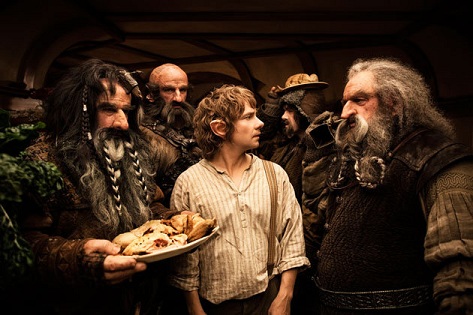
J.R.R. Tolkien’s The Hobbit begins with an unexpected dinner party. Bilbo, the reluctant host, is not expecting guests and empties his pantry to accommodate their arrival:

“Quite a merry gathering! I hope there is something left for the late-comers to eat and drink! What’s that? Tea! No thank you! A little red wine, I think for me.”
“And for me,” said Thorin.
“And raspberry jam and apple-tart,” said Bifur.
“And mince-pies and cheese,” said Bofur.
“And pork-pie and salad,” said Bombur.
 “And more cakes—and ale—and coffee, if you don’t mind,” called the other dwarves through the door.
 “Put on a few eggs, there’s a good fellow!” Gandalf called after him, as the hobbit stumped off to the pantries. “And just bring out the cold chicken and pickles!”

As the host, Bilbo knows his duty and is willing to go without food to make certain his guests have enough. He is careful not to offend those he has welcomed into his home. This is an adventure story that Tolkien wrote for his children, after all, and the tone is lighthearted at the start, although it does not end with the typical “happy ever after.” The epic adventure that follows in The Lord of the Rings is a different type of story altogether, and the subtle change in both language and tone at the start gives the reader fair warning of the darkness and intrigue that will develop throughout the novels.
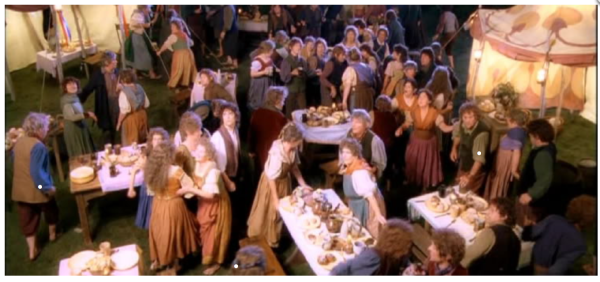
Screen Shot 2017-12-24 at 3.25.06 PMThe Lord of the Rings: The Fellowship of the Ringbegins in a similar manner to The Hobbit with a birthday party for Bilbo (shared with Frodo of course). There is an overabundance of food, even by the standards of hobbits, and yet the host’s courtesy is gone. Bilbo concludes the evening by making an insulting speech and playing a trick on his guests. This breech of civility is in its own way foreshadowing the negative effect of the ring on Bilbo. It has eaten away at him, as he later confesses to Gandalf, leaving him feeling thin, “like butter that has been scraped over too much bread.” The fact that Tolkien describes the effect of the ring in terms of food highlights this connection.
  Screen Shot 2017-12-24 at 3.25.22 PM

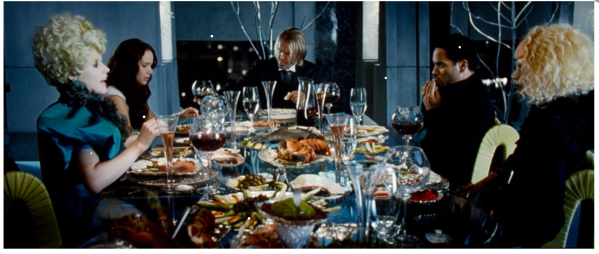
One of the most successful speculative fiction series of recent times, The Hunger Games, focuses on food as a way to explain the power dynamics in a culture. Almost every scene in the series of novels revolves around food in some way, from the starvation in the districts, Katniss’s hunting and foraging in the forest near her home and in the arena, the meals on the trains, the heavily controlled food portions in District 13, and the excess in the capital. Characters are associated with food: Peeta and bread; his father and cookies; the Mayor and strawberries; Greasy Sae and questionable beef; Rue and grooslings. The control over and distribution of food equates to power. This even occurs at the familial level when, at the start of the first book, Katniss is at odds with her mother because of the older woman’s mental collapse and the following exchange occurs:
One time, my mother told me that I always eat like I’ll never see food again. And I said, “I won’t unless I bring it home.” That shut her up.
The balance of power in the relationship is established by which person literally “puts food on the table” and Katniss seems to revel in the fact that she wins that battle. It’s one of the moments in the series when Katniss’s anger is not directed toward the capital, although their policies are the base cause of her tension with her mother.

There is more to a story than wonderful characters, evocative prose, stirring adventures, and exciting battles. World building by authors is far more than creating descriptive passages about landscapes, villages, or towns. Meanings are encoded in the texts and some symbols—like Tolkien’s One Ring or Collins’s Mockingjay Pin—will grab a reader’s immediate attention. They are too obvious to be overlooked. Others, like the ideas behind “how, why, and where” food fits into the society, are subtle: they add meaning to the story without waving a red flag in the narrative itself and pointing at the symbol as being particularly significant. * Yet their inclusion influences the meaning of the story and creates a richer story world experience for the reader.

*Writers do give us hints of course! Just look at the titles of the works, or at the chapter titles.

Take a peek at the Unquiet Dead, the first book in Chris Pavesic's newest series, the Chiaroscuro Chronicles. Blogcatherine

In Chiaroscuro it’s important to keep the faith.


When the Temples north of Chiaroscuro are burned and followers of the Sun Goddess are murdered, Catherine, a bard of the Ealdoth Temple, sets out to find those responsible and to bring them to justice. With only the help of a traveling group of minstrels and a retired fae investigator, Catherine must solve the mystery before more people are killed. So saddle up your clockwork mount, buckle on your electro-dagger, and join Catherine as she finds herself pitted against members of her own Temple, rogue members of the Seelie Court, and a seemingly unstoppable army of undead.

Purchase Your Copy from Amazon 


IMG_0886About the Author Chris Pavesic lives in the Midwestern United States and loves Kona coffee, fairy tales, steampunk, and all types of speculative fiction. Between writing projects, Chris can most often be found reading, gaming, gardening, working on an endless list of DIY household projects, or hanging out with friends. Learn more about her at chrispavesic.com References
  • Adams, D. (2010). The Ultimate Hitchhiker’s Guide to the Galaxy. [Kindle Edition.] Random House, Inc.
  • Collins, S. (2009). The Hunger Games. [Kindle Edition.] Scholastic Books.
  • Tolkien, J.R.R. (2009). The Hobbit. [Kindle Edition.] Harper Collins, Inc.

Thursday, 8 March 2018

Book Tour: Unquiet Dead by Chris Pavesic...


About Unquiet Dead:

In Chiaroscuro it’s important to keep the faith.

When the Temples north of Chiaroscuro are burned and followers of the Sun Goddess are murdered, Catherine, a bard of the Ealdoth Temple, sets out to find those responsible and to bring them to justice. With only the help of a traveling group of minstrels and a retired fae investigator, Catherine must solve the mystery before more people are killed.

So saddle up your clockwork mount, buckle on your electro-dagger, and join Catherine as she finds herself pitted against members of her own Temple, rogues members of the Seelie Court, and a seemingly unstoppable army of undead.


Unquiet Dead
Chiaroscuro Chronicles, Book 1
Chris Pavesic

140 pages

Genres: Steampunk, Mystery, Dark Fantasy

Learn More About Unquiet Dead:

Amazon

Goodreads

Facebook

Follow the virtual tour and visit tours hosts sharing spotlights, excerpts, and reviews. Link to tour schedule:

https://saphsbookpromotions.blogspot.com/2018/03/virtual-book-tour-schedule-unquiet-dead.html


Read an Excerpt:

“I’m glad to see you’re talking again.” Benedict glanced at her, his eyes kind. “Did you work out whatever was bothering you?”

Catherine gave him a wry smile. “No.”

“Want to talk about it? I can be a good listener.”

“No.” She stared down at her shoe as she tapped it against the smooth wooden footrest of the wagon. “Not now,” she added, to take some of the sting out of her reply. “I need to get my thoughts clear before I discuss them with another person. But I appreciate the offer.”

“Suit yourself.” He sighed and dragged a hand through his hair.

“We do not have to stop talking. Just…on a different subject.”

He smiled. “Lady’s choice.”

“Why did you undertake this job?”

“That’s direct. You don’t think it was for the money, then?”

“No, I don’t.”

“It’s an awful lot of money.”

“I don’t know you very well, but I have a feeling that you don’t do much only for the money.” She glanced at the horses, the reality in front of her. “Those animals are proof of that. Clean, well-fed, and happy. With little red ribbons in their hair. Most people would not be so kind.”

Benedict smiled at her comments and then his face grew sober. “A lot of the people who lived in those communities—they were friends. They were murdered, plain and simple, and no one seems to know who it was, who benefits from their deaths. It’s rare someone in my position would be able to do something about it.”

“You want to find the murderer or murderers and bring them to justice?”

His grip tightened inadvertently on the reins. “I want to find out who killed them and bring a reckoning.”

Meet the Author:


Chris Pavesic lives in the Midwestern United States and loves Kona coffee, fairy tales, and all types of speculative fiction. Between writing projects, Chris can most often be found reading, gaming, gardening, working on an endless list of DIY household projects, or hanging out with friends.

Find Chris Pavesic Online:


Twitter Handle @chrispavesic


Monday, 26 February 2018

Cover Reveal and New Book Release: Unquiet Dead by Chris Pavesic...


Blogcatherine

Unquiet Dead

Chris Pavesic


Screen Shot 2018-01-12 at 7.55.36 PM

About the Unquiet Dead: 

In Chiaroscuro it’s important to keep the faith.

When the Temples north of Chiaroscuro are burned and followers of the Sun Goddess are murdered, Catherine, a bard of the Ealdoth Temple, sets out to find those responsible and to bring them to justice. With only the help of a traveling group of minstrels and a retired fae investigator, Catherine must solve the mystery before more people are killed.

So saddle up your clockwork mount, buckle on your electro-dagger, and join Catherine as she finds herself pitted against members of her own Temple, rogues members of the Seelie Court, and a seemingly unstoppable army of undead.

Genres: Steampunk/Mystery/Dark Fantasy 

Length: 140 pages. 
Available in Print and E-Book 

Add to Your Shelf on Goodreads 

Purchase Your Copy from Amazon 

Learn More on Facebook


Excerpt

Services were scheduled to commence in an hour, and Ernest needed to be ready. He struck a match and lit the first gaslight, watching the flame take hold and flare up. The light pushed back the shadows so parishioners were able to find their way to the pews without stumbling. He would extinguish the artificial lights right before the service so the effect of the sunlight illuminating the darkness hit with maximum impact as it flooded through the skylights. 
The parishioners would marvel at how the Temple filled with the Goddess’s Holy Light just in time for the service. Ernest would marvel at the fact that none of them were smart enough to realize he flipped a switch on back of the altar to swing open mechanical shutters. 
There was a religious stirring in Grand Marsh more powerful than anything Ernest had experienced in his ten years as a Sacerd. The services at dawn, noon, and sundown were packed. Few of the farmers went out to the fields. They worked in town on community projects or sat drinking at the tavern. Their wives remained in the town square, full of chatter, instead of staying on their farmsteads. Their thin voices filled the air. The youngest children were kept close while the teens clustered in protective packs far enough away to keep their discussions out of reach of their parents’ ears. But close enough to be in sight at all times. None of them wandered off. 
Three times a day they filled the Temple, ready to hear his words. Faces tilted up to him. Man and woman, young and old. And none of his parishioners would confess why they were so filled with the Holy Spirit that they were neglecting their farms. They were afraid of speaking blasphemy. But he knew the reason, and it caused a lift in his heart that was not due to religious inspiration. They were scared, plain and simple, and it gave him hope. 
Since being assigned to the far parish almost five years ago, a posting he saw as an end to the upward progress of his career in the Temple, he struggled daily to swallow his disappointment. It wouldn’t leave, and it was bitter. Bitter. 
In this remote village, far from the bustle and industry of Chiaroscuro, the quality of his life, the texture of his life, changed. He longed for life in the city. The world seemed to have shifted into two zones. The pace of life for the city dwellers increased while people living in the countryside were being left behind. 
Time’s arrow struck fastest through the densest populations. Sacerds assigned to any of the major cities made more connections and accumulated more power in a single week than he did in a year. Exerting influence was impossible when the spheres of power were spinning outside of his reach, moving too fast for him to see, let alone have an impact. 
The wound to his pride stung the most. The elders had hurt his feelings. To be dismissed so easily, passed along so casually—it was like the swatting of an annoying insect. The Temple elders did not treat him as if he mattered, as if his family ties were consequential. True he was a third son, but of a noble line. And they assigned him to a rustic Temple to attend to common folk far below his station. 
Very little was required of him here. Or, more precisely, very little of what he did here interested him. He burned to return to the central Temple and to be part of the intrigues and power shifts. This attracted him more than caring for the simple souls of farmers and shopkeepers. Power was why he joined the Temple, and what he was now denied. 
But not for long. The thought clanged in his mind with undeniable rightness. Not righteousness. It was an important distinction. Would the Goddess sanction his actions? Probably not, but he was past caring about her approval. During all of the ceremonies, all of the prayer and introspection, he had never felt any divine presence. He had never witnessed any miracles, and doubted their existence. 
But power, oh he had seen the existence of power. Political. Social. Religious. Whatever you called it really didn’t matter. Get enough people to follow you. Enough people to believe in what you were selling. This was the belief that could move the world. 
There was only one woman in his life he needed to please now, and she held no divinity. Merci had offered him a way out of this rural purgatory, and he had accepted. Truth be told, he had grabbed at it like a castaway might grab at a line from a passing airship. If the price were the damnation of his soul, so be it. 
He glanced out the window at the transport coming down the lane. A high quality clockwork carriage with the Temple’s Crest stamped on the doors rattled over the boards strewn across the irrigation ditch and stopped, parking in the speckled light cast by the ornament trees planted along the lane. The carriage blocked traffic, but the driver did not seem to care. Elder members of the clergy, Hlytere, and above, felt they had the right of way. Others had to go around. 
A pale, dark-haired woman emerged and stood for a moment looking around. She pulled the hood of her dark cloak over her hair and walked through the yard toward the Temple. Ernest’s gaze followed her, trying to imagine who this stranger was. 
Her footsteps sounded in the aisle and, when he turned from window, she was almost upon him. Her speed startled him. When he saw her face to face he realized she was younger than he had supposed. Too young to be a Hlytere, but her use of the carriage meant she was favored by the Temple elders. The seed of jealousy radiated through him. He felt it in his chest and the pit of his stomach. He struggled to keep the emotion off his face. “Greetings.” He shook her hand with a firm grasp. Her hands were small and smooth and white. “Will you come in for a moment?” He led her to the small reception room off the main area that contained a round table and several wooden chairs. He lit a cheroot, offered her one, which she declined, and they sat down. 
“Please forgive me for calling on you so close to mid-day Services, Sacerd Ernest.” She paused. “You are Sacerd Ernest, correct? It’s not like me to presume.” 
“Of course. I’m glad you came. I watched you drive up, you know, and I wondered who you were. We don’t get many visitors from the Temple here.” 
“I’m surprised you don’t recognize me, cousin. Of course, I didn’t recognize you. So perhaps it’s not so surprising.” 
“I’m sorry. I …” 
“I’m from the cadet line of our family tree. My father is the elder son of the younger son of our line.” 
His brow creased in thought. “Grace?” 
“Yes,” she said with a smile, reaching out to touch his hand. Her fingers rested there for a moment too long. Lingered. And then she leaned back in the chair and crossed her legs, which were slim and bare beneath her robe. 
Sacerd Ernest regarded his guest, wondering that her physical presence should suddenly dawn upon him so. She was more beautiful than he had thought at first. Her skin was clear and lovely, and her eyes and mouth were made up carefully and well. 
What’s her game? He licked at the perspiration that appeared upon his upper lip. 
“I would like your help in a small matter. And of course I wanted to meet you.” 
“You did?” 
“Our sponsor has spoken of you with such affection.” 
“Our superior?” He used the wrong word to see if she would correct him. 
“Technically, I suppose, she may be yours. I’ve never thought much of the rules of hierarchy in the Temple.” She cocked her head, listening to noises from the other room. Some of his parishioners had started to file in for the service. “It’s such a mercy, isn’t it?’ 
Ah, code words. 
She must think she’s being clever, although he had no idea who could possibly overhear their conversation. It was only just dawning on him why she must be here. In his town. In his Temple. But he didn’t care. All he wanted to do was get out of Grand Marsh. Get back to Chiaroscuro. It didn’t bother him that people, his parishioners, may die, or suffer a fate worse than death. He just wanted to get out. 
It’s not my fault if I’m following orders. 
But that was a poor excuse, wasn’t it? Guilt flared, hot and strong. 
Do you want to stay in Grand Marsh forever? Ministering to the townsfolk? Do you? 
No … but he didn’t want to hurt people. Those conflicting thoughts pulled at him. There was the question of right and wrong. What was right for him might go wrong for others. But that was the way it had to be. 
Thus he banished the guilt. When something inside of him tried to protest again, tried to tell him to think before he did this, he smothered it. 
“When?” He didn’t have any time for nonsense. The quicker it occurred, the quicker he resumed his rightful place. 
“In two days. I have some items in my transport that need to be set up in the Temple, but kept out of view.” She smiled and spoke a little louder so that the earliest arrivals overheard her. “I wish I could stay to help with the Mass, but I am needed back in Chiaroscuro.” She lowered her voice. “Officially I never left the city.” 
“Of course.” He guessed that she had no desire to partake in the service. “I will help you with whatever you need.” Whatever may come of it, he had gone too far to stop now.
Meet the Author:

Chris Pavesic lives in the Midwestern United States and loves Kona coffee, fairy tales, and all types of speculative fiction. Between writing projects, Chris can most often be found reading, gaming, gardening, working on an endless list of DIY household projects, or hanging out with friends.

Find Chris Pavesic Online:

Website
Amazon Author Page
Facebook Author Page
Tweets @chrispavesic