“The History of every major Galactic Civilization tends to pass through three distinct and recognizable phases, those of Survival, Inquiry and Sophistication, otherwise known as the How, Why, and Where phases. For instance, the first phase is characterized by the question ‘How can we eat?’ the second by the question ‘Why do we eat?’ and the third by the question ‘Where shall we have lunch?’” –Douglas Adams, The Restaurant at the End of the Universe
In elementary school children learn that the basic needs are air, water, food, and shelter in that order of importance. The need for other things, like love, security, and meaning, are lower on the level of significance. Anthropologists study the eating habits of a society in both basic forms and elaborate ritual purposes in order to gain cultural insights. The acts of obtaining, preparing, distribution, and eating of food are a fundamental part of a culture’s infrastructure. Is it any wonder, then, that food plays a principal role in the world-building of fiction realms and that some of the most famous and successful speculative fiction authors like Douglas Adams, J.R.R. Tolkien, and Suzanne Collins devote a extraordinary amount of narrative time to the central questions of how, why, and where their characters eat?
J.R.R. Tolkien’s
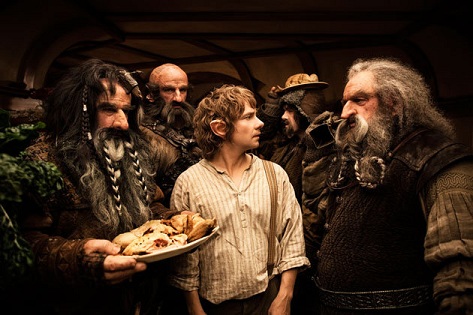
The Hobbit begins with an unexpected dinner party. Bilbo, the reluctant host, is not expecting guests and empties his pantry to accommodate their arrival:
“Quite a merry gathering! I hope there is something left for the late-comers to eat and drink! What’s that? Tea! No thank you! A little red wine, I think for me.”
“And for me,” said Thorin.
“And raspberry jam and apple-tart,” said Bifur.
“And mince-pies and cheese,” said Bofur.
“And pork-pie and salad,” said Bombur.
“And more cakes—and ale—and coffee, if you don’t mind,” called the other dwarves through the door.
“Put on a few eggs, there’s a good fellow!” Gandalf called after him, as the hobbit stumped off to the pantries. “And just bring out the cold chicken and pickles!”
As the host, Bilbo knows his duty and is willing to go without food to make certain his guests have enough. He is careful not to offend those he has welcomed into his home. This is an adventure story that Tolkien wrote for his children, after all, and the tone is lighthearted at the start, although it does not end with the typical “happy ever after.” The epic adventure that follows in
The Lord of the Rings is a different type of story altogether, and the subtle change in both language and tone at the start gives the reader fair warning of the darkness and intrigue that will develop throughout the novels.
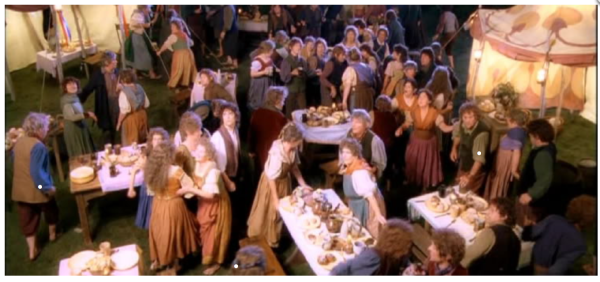 The Lord of the Rings: The Fellowship of the Ringbegins in a similar manner to The Hobbit with a birthday party for Bilbo (shared with Frodo of course). There is an overabundance of food, even by the standards of hobbits, and yet the host’s courtesy is gone. Bilbo concludes the evening by making an insulting speech and playing a trick on his guests. This breech of civility is in its own way foreshadowing the negative effect of the ring on Bilbo. It has eaten away at him, as he later confesses to Gandalf, leaving him feeling thin, “like butter that has been scraped over too much bread.” The fact that Tolkien describes the effect of the ring in terms of food highlights this connection.
One of the most successful speculative fiction series of recent times,
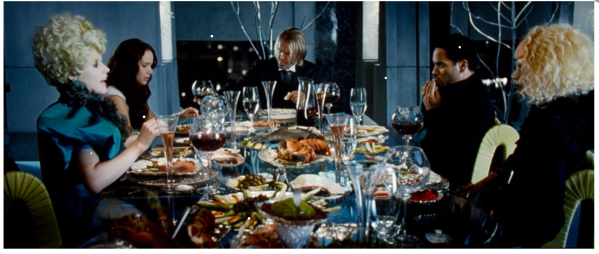
The Hunger Games, focuses on food as a way to explain the power dynamics in a culture. Almost every scene in the series of novels revolves around food in some way, from the starvation in the districts, Katniss’s hunting and foraging in the forest near her home and in the arena, the meals on the trains, the heavily controlled food portions in District 13, and the excess in the capital. Characters are associated with food: Peeta and bread; his father and cookies; the Mayor and strawberries; Greasy Sae and questionable beef; Rue and grooslings. The control over and distribution of food equates to power. This even occurs at the familial level when, at the start of the first book, Katniss is at odds with her mother because of the older woman’s mental collapse and the following exchange occurs:
One time, my mother told me that I always eat like I’ll never see food again. And I said, “I won’t unless I bring it home.” That shut her up.
The balance of power in the relationship is established by which person literally “puts food on the table” and Katniss seems to revel in the fact that she wins that battle. It’s one of the moments in the series when Katniss’s anger is not directed toward the capital, although their policies are the base cause of her tension with her mother.
There is more to a story than wonderful characters, evocative prose, stirring adventures, and exciting battles. World building by authors is far more than creating descriptive passages about landscapes, villages, or towns. Meanings are encoded in the texts and some symbols—like Tolkien’s One Ring or Collins’s Mockingjay Pin—will grab a reader’s immediate attention. They are too obvious to be overlooked. Others, like the ideas behind “how, why, and where” food fits into the society, are subtle: they add meaning to the story without waving a red flag in the narrative itself and pointing at the symbol as being particularly significant. * Yet their inclusion influences the meaning of the story and creates a richer story world experience for the reader.
*Writers do give us hints of course! Just look at the titles of the works, or at the chapter titles.
Take a peek at the
Unquiet Dead, the first book in Chris Pavesic's newest series, the Chiaroscuro Chronicles.

In Chiaroscuro it’s important to keep the faith.
When the Temples north of Chiaroscuro are burned and followers of the Sun Goddess are murdered, Catherine, a bard of the Ealdoth Temple, sets out to find those responsible and to bring them to justice. With only the help of a traveling group of minstrels and a retired fae investigator, Catherine must solve the mystery before more people are killed.
So saddle up your clockwork mount, buckle on your electro-dagger, and join Catherine as she finds herself pitted against members of her own Temple, rogue members of the Seelie Court, and a seemingly unstoppable army of undead.
Purchase
Your Copy from Amazon
 About the Author
Chris Pavesic lives in the Midwestern United States and loves Kona coffee, fairy tales, steampunk, and all types of speculative fiction. Between writing projects, Chris can most often be found reading, gaming, gardening, working on an endless list of DIY household projects, or hanging out with friends.
Learn more about her at chrispavesic.com
References
- Adams, D. (2010). The Ultimate Hitchhiker’s Guide to the Galaxy. [Kindle Edition.] Random House, Inc.
- Collins, S. (2009). The Hunger Games. [Kindle Edition.] Scholastic Books.
- Tolkien, J.R.R. (2009). The Hobbit. [Kindle Edition.] Harper Collins, Inc.


 Chris Pavesic is a fantasy author who lives in the Midwestern United States and loves Kona coffee, steampunk, fairy tales, and all types of speculative fiction. Between writing projects, Chris can most often be found reading, gaming, gardening, working on an endless list of DIY household projects, or hanging out with friends.


