Showing posts with label Fantasy Author. Show all posts

Sunday, 29 January 2023

Guest Post: A Shapeshifter Called Harper by Author Carol Browne...


You’re expecting to read about a shapeshifter called Harper now, I know, but it’s why this character is called Harper that is the reason for me writing this blog. The name was originally Tyler.

Tyler was the MC in a sci-fi novella entitled The Star Attraction, which I wrote in 2016. In May 2019, I was offered a contract for the book by my publisher. Said publisher closed down a few months later and that was that. Following this, I found myself dealing with a multitude of life problems, not to mention my other books and the demise of my third publisher. Hence, it was only in July 2022 that I found time to submit this book elsewhere (no verdict as yet!). Meanwhile, I am writing a sequel.

This week I saw a promo post on Facebook for a new release and, lo and behold, the male protagonist is a shapeshifter called Tyler. What are the odds? I might have been the first person to use this name in this way, but the other author got published so Tyler is damned and has morphed into Harper (which seems apt).

In this same week, a fellow author was distraught when she found that her latest manuscript, which she was about to send to her agent, has the same theme as another recently published book. I won’t reveal the theme, but it is such a novel, specific and original concept that it beggars belief that someone else came up with the very same idea. I hope she and her agent can find a way around this dilemma.

Last year I had an idea for a crime thriller, and I believed that the crime and the reason behind it was so outlandish and original that the chance of anyone else coming up with the idea was remote. More fool me. Yet another of those promo posts on Facebook was to show me the error of my ways as a concept I had deemed so unusual and unique was there for all to see in someone else’s stylish new book trailer. Meanwhile, as I toyed with the idea of an epic fantasy involving women with magic powers, I found that my story had already been given its marching orders by The Wheel of Time.

When there’s nothing new under the sun, it’s a challenge trying to create original concepts, and even more difficult to avoid accusations of plagiarism even though you had no idea that your ideas duplicated someone else’s. In the same way, it’s not possible to be aware of every book that has been, is being, or will be published. The fact that there’s no copyright on titles is a small crumb of comfort!

So, what is going on? Is it the Collective Unconscious that causes so many people to have the same ideas at the same time? How often does this happen to other authors and what do they do about it? Would any author reading this blog have changed Tyler to Harper or kept the original name? I’d love to know.

For now, my shapeshifter is called Harper. I lay claim to this in writing in the hope that there aren’t any other shapeshifters called Harper out there already! If there are and anyone has any objection to mine, speak now or forever hold your peace!

Once upon a time a little girl wrote a poem about a flower.
Impressed, her teacher pinned it to the wall and, in doing so, showed the child which path to follow.

Over the years poems and stories flowed from her pen like magic from a wizard’s wand.

She is much older now, a little wiser too, and she lives in rural Cambridgeshire, where there are many trees to hug.

But inside her still is that little girl who loved Nature and discovered the magic of words.

She hopes to live happily ever after.

Stay connected with Carol on her website and blog, Facebook, and Twitter

Fantasy author Carol Browne is a published author who is currently seeking an agent.

Monday, 25 May 2020

Time to Play the Game and Pop the Caramel Corn with Fantasy Author Chris Pavesic...

Is there anything better than homemade sweet and salty caramel corn? Not only does it taste delicious, the aroma that fills the air when you are cooking it is heavenly.

Baked Caramel Corn

Nonstick cooking spray
24 cups air popped popcorn
1 cup (2 sticks) butter or margarine
2 cups firmly packed brown sugar
½ cup light or dark corn syrup
1 tsp. salt ½ tsp. baking soda
1 tsp. vanilla extract

Preheat oven to 250°F.

Coat bottom and sides of large roasting pan with nonstick spray. Place popped popcorn in roasting pan.

In saucepan, slowly melt butter. Stir in brown sugar, corn syrup, and salt. Heat to a boil, stirring constantly. Boil without stirring 5 minutes. Remove from heat. Stir in baking soda and vanilla. 

Gradually pour over popped popcorn, mixing well. Bake for 1 hour, stirring every 15 minutes.

Remove from oven, and cool completely. Break apart and store in tightly covered container.

While you enjoy your treat why not read a good book? May I suggest one of the books from my LitRPG series The Revelation Chronicles?

In Starter Zone Cami kept herself and her younger sister Alby alive in a post-apocalyptic world, facing starvation, violence, and death on a daily basis. Caught by the military and forcefully inscribed, Cami manages to scam the system and they enter the Realms, a Virtual Reality world, as privileged Players rather than slaves. They experience a world of safety, plenty, and magical adventure.

In the Traveler's Zone magic, combat, gear scores, quests, and dungeons are all puzzles to be solved as Cami continues her epic quest to navigate the Realms and build a better life for her family. But an intrusion from her old life threatens everything she has gained and imperils the entire virtual world. 

Time to play the game.

Above the tree line floats an airship close to three hundred feet long with a slightly rounded wooden hull. Ropes attach the lower portion of the ship to an inflated balloon-like aspect, bright white in color with an identification symbol, a red bird with white-tipped feathers extended in flight, inside a round yellow circle in the center of the canvas. The deck is manned with archers and swordsmen. There are two sets of fore and aft catapults.

What I don’t see are cannons or any other type of a gun large enough to account for the sound of the explosion.

The ship pivots in the air, coming around to point directly at what looks like an oncoming flock of five large birds. Or creatures. They are too big and too strange looking to be birds. They drift closer, flapping their wings.

A moment passes before I realize that they are not creatures either. They are some sort of gliders. A person hangs below each set of the feathered wings, which flap and move with mechanical precision in a sky washed out by the morning sun.

The archers nock their arrows and aim at the flock.

The gliders draw in their wings and dive toward the deck, covering the distance in a few heartbeats. Most of the arrows fly uselessly past the attack force and fall like black rain from the sky. The archers aimed and released the volley too late.

The forward catapult releases a torrent of small rocks at the lead glider. It is a scatter-shot approach that proves effective. There are so many missiles that it is impossible to dodge them all. But at the moment the stones strike, the other four let loose with fireballs. Spheres of crackling flame spring from their hands, glowing faintly at first and then with increasing brightness. The balls of fire shoot from their hands like bullets from a gun and fly toward the ship, exploding. Pieces bounce off the hull and fall to the ground, throwing hissing, burning globs of magic-fueled fire in all directions, setting everything they touch aflame.

Want to learn more about The Revelation Chronicles? Click HERE for updates on this and the other series by Chris. Watch the video on YouTube.

Chris Pavesic is a fantasy author who lives in the Midwestern United States and loves Kona coffee, steampunk, fairy tales, and all types of speculative fiction. Between writing projects, Chris can most often be found reading, gaming, gardening, working on an endless list of DIY household projects, or hanging out with friends. 

Learn more about Chris on her website and blog.

Stay connected on Facebook, Twitter, and her Amazon Author Page.

Monday, 2 September 2019

Labor Day Lemony Blueberry Breakfast Bread by Chris Pavesic...

Now that all the blueberries have been harvested during August, Fantasy author Chris Pavesic has a yummy suggestion on what to do with those tasty blue treats. Take it away, Chris...

Enjoy this delicious and easy bread any time of the year. Fresh or frozen blueberries work great. Make extra, the bread freezes and thaws beautifully.

Lemony Blueberry Bread


¾ cup brown sugar
2 tbsp. milk
1 tbsp. vegetable oil
6 oz. blueberry yogurt
1 large egg
1 tsp. almond extract
2 cups all-purpose flour
2 tsp. baking powder
1 cup blueberries (fresh or frozen)
1 tbsp. all-purpose flour

PREHEAT oven to 350ᵒ F.

IN a medium bowl, stir together sugar, milk, oil, yogurt, egg, and extract. In a separate bowl, combine flour with baking powder. Add the dry ingredients to the wet ingredients and stir until combined.

IN a small bowl, toss blueberries with 1 tablespoon of flour.

FOLD blueberries gently into batter.

POUR the batter into a greased 9 x 5 inch loaf pan. Bake 50 to 55 minutes or until a toothpick inserted into the center of the loaf comes out clean. Allow bread to cool for 10 minutes before turning onto a rack to cool completely.

Lemon Glaze (optional)

⅓ cup fresh lemon juice
⅓ cup white sugar

COMBINE lemon juice and sugar in a small saucepan. Cook over medium heat until sugar is dissolved and then cook an additional 3 minutes. Let glaze cool a bit. Poke small holes in the top of cake and then pour glaze over the bread before removing it from the pan.

While your home fills with a tasty aroma, indulge yourself with a good book. May I suggest one of the books from my LitRPG series The Revelation Chronicles?

In Starter Zone Cami kept herself and her younger sister Alby alive in a post-apocalyptic world, facing starvation, violence, and death on a daily basis. Caught by the military and forcefully inscribed, Cami manages to scam the system and they enter the Realms, a Virtual Reality world, as privileged Players rather than slaves. They experience a world of safety, plenty, and magical adventure.

In the Traveler's Zone magic, combat, gear scores, quests, and dungeons are all puzzles to be solved as Cami continues her epic quest to navigate the Realms and build a better life for her family. But an intrusion from her old life threatens everything she has gained and imperils the entire virtual world.

Time to play the game.

Above the tree line floats an airship close to three hundred feet long with a slightly rounded wooden hull. Ropes attach the lower portion of the ship to an inflated balloon-like aspect, bright white in color with an identification symbol, a red bird with white-tipped feathers extended in flight, inside a round yellow circle in the center of the canvas. The deck is manned with archers and swordsmen. There are two sets of fore and aft catapults.

What I don’t see are cannons or any other type of a gun large enough to account for the sound of the explosion.

The ship pivots in the air, coming around to point directly at what looks like an oncoming flock of five large birds. Or creatures. They are too big and too strange looking to be birds. They drift closer, flapping their wings.

A moment passes before I realize that they are not creatures either. They are some sort of gliders. A person hangs below each set of the feathered wings, which flap and move with mechanical precision in a sky washed out by the morning sun.

The archers nock their arrows and aim at the flock.

The gliders draw in their wings and dive toward the deck, covering the distance in a few heartbeats. Most of the arrows fly uselessly past the attack force and fall like black rain from the sky. The archers aimed and released the volley too late.

The forward catapult releases a torrent of small rocks at the lead glider. It is a scatter-shot approach that proves effective. There are so many missiles that it is impossible to dodge them all.

But at the moment the stones strike, the other four let loose with fireballs. Spheres of crackling flame spring from their hands, glowing faintly at first and then with increasing brightness. The balls of fire shoot from their hands like bullets from a gun and fly toward the ship, exploding. Pieces bounce off the hull and fall to the ground, throwing hissing, burning globs of magic-fueled fire in all directions, setting everything they touch aflame.


Want to learn more about The Revelation Chronicles? Click HERE for updates on this and the other series by Chris. Watch the video on YouTube.

  4eee6-chris2bpavesic2bauthor2bphoto

Chris Pavesic is a fantasy author who lives in the Midwestern United States and loves Kona coffee, steampunk, fairy tales, and all types of speculative fiction. Between writing projects, Chris can most often be found reading, gaming, gardening, working on an endless list of DIY household projects, or hanging out with friends.

Learn more about Chris on her website and blog.

Stay connected on Facebook, Twitter, and her Amazon Author Page.

Monday, 19 November 2018

World Building by Fantasy Author Chris Pavesic...

Hobbit Food
“The History of every major Galactic Civilization tends to pass through three distinct and recognizable phases, those of Survival, Inquiry and Sophistication, otherwise known as the How, Why, and Where phases. For instance, the first phase is characterized by the question ‘How can we eat?’ the second by the question ‘Why do we eat?’ and the third by the question ‘Where shall we have lunch?’” –Douglas Adams, The Restaurant at the End of the Universe
In elementary school children learn that the basic needs are air, water, food, and shelter in that order of importance. The need for other things, like love, security, and meaning, are lower on the level of significance. Anthropologists study the eating habits of a society in both basic forms and elaborate ritual purposes in order to gain cultural insights. The acts of obtaining, preparing, distribution, and eating of food are a fundamental part of a culture’s infrastructure. Is it any wonder, then, that food plays a principal role in the world-building of fiction realms and that some of the most famous and successful speculative fiction authors like Douglas Adams, J.R.R. Tolkien, and Suzanne Collins devote a extraordinary amount of narrative time to the central questions of how, why, and where their characters eat?

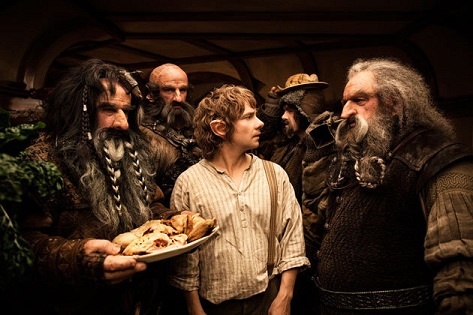
J.R.R. Tolkien’s The Hobbit begins with an unexpected dinner party. Bilbo, the reluctant host, is not expecting guests and empties his pantry to accommodate their arrival:

“Quite a merry gathering! I hope there is something left for the late-comers to eat and drink! What’s that? Tea! No thank you! A little red wine, I think for me.”
“And for me,” said Thorin.
“And raspberry jam and apple-tart,” said Bifur.
“And mince-pies and cheese,” said Bofur.
“And pork-pie and salad,” said Bombur.
 “And more cakes—and ale—and coffee, if you don’t mind,” called the other dwarves through the door.
 “Put on a few eggs, there’s a good fellow!” Gandalf called after him, as the hobbit stumped off to the pantries. “And just bring out the cold chicken and pickles!”

As the host, Bilbo knows his duty and is willing to go without food to make certain his guests have enough. He is careful not to offend those he has welcomed into his home. This is an adventure story that Tolkien wrote for his children, after all, and the tone is lighthearted at the start, although it does not end with the typical “happy ever after.” The epic adventure that follows in The Lord of the Rings is a different type of story altogether, and the subtle change in both language and tone at the start gives the reader fair warning of the darkness and intrigue that will develop throughout the novels.

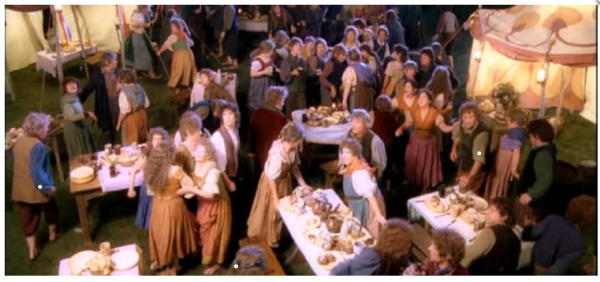
Screen Shot 2017-12-24 at 3.25.06 PMThe Lord of the Rings: The Fellowship of the Ringbegins in a similar manner to The Hobbit with a birthday party for Bilbo (shared with Frodo of course). There is an overabundance of food, even by the standards of hobbits, and yet the host’s courtesy is gone. Bilbo concludes the evening by making an insulting speech and playing a trick on his guests. This breech of civility is in its own way foreshadowing the negative effect of the ring on Bilbo. It has eaten away at him, as he later confesses to Gandalf, leaving him feeling thin, “like butter that has been scraped over too much bread.” The fact that Tolkien describes the effect of the ring in terms of food highlights this connection.

  Screen Shot 2017-12-24 at 3.25.22 PM

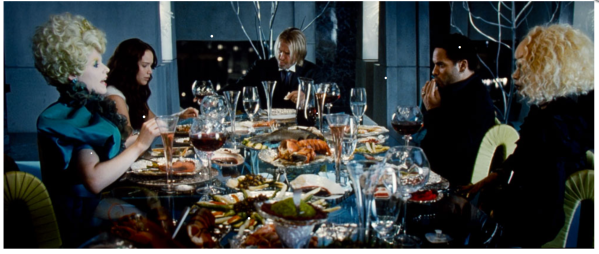
One of the most successful speculative fiction series of recent times, The Hunger Games, focuses on food as a way to explain the power dynamics in a culture. Almost every scene in the series of novels revolves around food in some way, from the starvation in the districts, Katniss’s hunting and foraging in the forest near her home and in the arena, the meals on the trains, the heavily controlled food portions in District 13, and the excess in the capital. Characters are associated with food: Peeta and bread; his father and cookies; the Mayor and strawberries; Greasy Sae and questionable beef; Rue and grooslings. The control over and distribution of food equates to power. This even occurs at the familial level when, at the start of the first book, Katniss is at odds with her mother because of the older woman’s mental collapse and the following exchange occurs:
One time, my mother told me that I always eat like I’ll never see food again. And I said, “I won’t unless I bring it home.” That shut her up.
The balance of power in the relationship is established by which person literally “puts food on the table” and Katniss seems to revel in the fact that she wins that battle. It’s one of the moments in the series when Katniss’s anger is not directed toward the capital, although their policies are the base cause of her tension with her mother.

There is more to a story than wonderful characters, evocative prose, stirring adventures, and exciting battles. World building by authors is far more than creating descriptive passages about landscapes, villages, or towns. Meanings are encoded in the texts and some symbols—like Tolkien’s One Ring or Collins’s Mockingjay Pin—will grab a reader’s immediate attention. They are too obvious to be overlooked. Others, like the ideas behind “how, why, and where” food fits into the society, are subtle: they add meaning to the story without waving a red flag in the narrative itself and pointing at the symbol as being particularly significant. * Yet their inclusion influences the meaning of the story and creates a richer story world experience for the reader.

*Writers do give us hints of course! Just look at the titles of the works, or at the chapter titles.

Take a peek at the Unquiet Dead, the first book in Chris Pavesic's newest series, the Chiaroscuro Chronicles. Blogcatherine

In Chiaroscuro it’s important to keep the faith.


When the Temples north of Chiaroscuro are burned and followers of the Sun Goddess are murdered, Catherine, a bard of the Ealdoth Temple, sets out to find those responsible and to bring them to justice. With only the help of a traveling group of minstrels and a retired fae investigator, Catherine must solve the mystery before more people are killed. So saddle up your clockwork mount, buckle on your electro-dagger, and join Catherine as she finds herself pitted against members of her own Temple, rogue members of the Seelie Court, and a seemingly unstoppable army of undead.

Purchase Your Copy from Amazon 


IMG_0886About the Author Chris Pavesic lives in the Midwestern United States and loves Kona coffee, fairy tales, steampunk, and all types of speculative fiction. Between writing projects, Chris can most often be found reading, gaming, gardening, working on an endless list of DIY household projects, or hanging out with friends. Learn more about her at chrispavesic.com References
  • Adams, D. (2010). The Ultimate Hitchhiker’s Guide to the Galaxy. [Kindle Edition.] Random House, Inc.
  • Collins, S. (2009). The Hunger Games. [Kindle Edition.] Scholastic Books.
  • Tolkien, J.R.R. (2009). The Hobbit. [Kindle Edition.] Harper Collins, Inc.

Monday, 1 October 2018

Guest Post: Believe in Your Writing, and Yourself by Andrew McDowell...


Sylvia Plath said the worst enemy to creativity is self-doubt. Yet the simple fact is every writer who is serious about his or her work will face it. I’m sure every writer can agree that they are their own worst critic. Ever since I became serious about my writing and getting published, I’ve been plagued by self-doubt and still am. Battling self-doubt is never easy, but it cannot be avoided either. So how can you overcome it?

Well, after you’ve invested so much time into a project, and so much passion, it becomes impossible not to see it through, which ties back to two of the Four P’s of Getting Published: patience and persistence. These virtues combined demonstrate the reverse of self-doubt: self-confidence. Certainly sometime it might not seem to exist, but even if you cannot see it, it must be there if you’ve waited and endured so long to see your writing become the best it can be.

Some writers see it instead as a challenge, one that you should enjoy taking on. Now that delight often only seems present in the moment; especially one has completed the first draft or the final one. But when it comes, relish in it, because you didn’t give up. You cannot sell yourself short, however much it or the world may seem to tell you to. If you give up, then self-doubt has won the battle, and your creativity will wither and die.

Yet as I previously stated, self-doubt is unavoidable. I continue to endure it even as I persevere. So what to do then? Well, self-doubt is rooted in fear – the fear of being rejected and criticized. We all feel fear. It too is unavoidable, something which Saershe states in my novel Mystical Greenwood. So the simple fact is it’s no use denying the presence of fear and self-doubt. And yet, that is how it can be defeated.

As Saershe tells my protagonists, one must accept that they feel fear to grow stronger, and only when acknowledging and face fear can one overcome it. That’s because by acknowledging you feel fear and self-doubt, it takes away its power to stop you. You will constantly battle it, and you won’t emerge unscathed, but you will emerge nonetheless, because your self-confidence endured and you believed in your writing, and yourself.

Further Reading
  1. Ambers, Lorraine. Dream Big and Don’t Hold You Back.
  2. Ambers, Lorraine. Positive quotes: Don’t Fear.
Book Blurb:
Mystical Greenwood, Book I of One with Nature

Dermot is a fifteen-year-old boy living in the land of Denú who has always longed for something more in life. His life changes when he encounters a gryphon and a mysterious healer. Drawn into a conflict against one determined to subjugate the kingdom, Dermot and his brother Brian are forced to leave their home.

A legendary coven must now reunite, for they are Denú’s greatest hope. In the course of meeting unicorns and fighting dragons and men in dark armor, Dermot discovers a deep, sacred magic which exists within every greenwood he crosses through, but his own role in this conflict is greater than he suspects. Can he protect those he loves, or will all that’s good be consumed by darkness?


Author Bio:
Andrew McDowell wanted to be a writer since he was a teenager. He studied at St. Mary’s College, and the University of Maryland for grad school. He is a member of the Maryland Writers’ Association and an associate nonfiction editor with the literary journal JMWW. Andrew has also written and published poetry and creative nonfiction. To learn more about him and his writing, visit his website and blog at andrewmcdowellauthor.com.

Social Media Links: Facebook | Twitter | YouTube | Google+ | Tumblr

Monday, 16 July 2018

Guest Post: Elves - the Good, the Bad, and the Awesome by Carol Browne...

Photo Courtesy of Fun Photos Pixabay
When Elgiva, the protagonist of my fantasy novel The Exile of Elindel, is forced to seek the society of humans in order to survive the winter, she can only do this by adopting a disguise. Although mythology insists that elves are shapeshifters, I have Elgiva borrow magic instead so she can change her appearance. Why would she need to do this? In these modern times, we have friendly elves that help Santa; we have the innocuous Elf on the Shelf; we have glamorous immortal beings like the elves in "Lord of the Rings" that fascinate us with their pointed ears and otherworldly beauty. Why on earth would an elf feel compelled to hide their true nature?

Belief in elves as actual beings is as old as belief in the Norse gods. Indeed Freyr, one of the gods most widely and ardently venerated by the Norse and Germanic peoples, dwelled in Alfheim, the elves’ homeland. Germanic Mythology described three divine races: the Aesir, the Vanir and the Alfar (the elves). The origins of the Vanir and Alfar are cloaked in mystery and the relationship between the gods and the elves was ambiguous enough to permit a number of possible connections between Freyr and the elves.
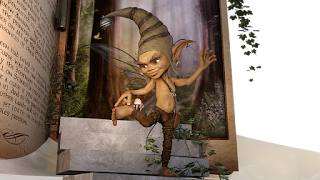
Photo Courtesy of The Royalmen Pixabay
However, godlike or not, elves were often seen as mischievous and spiteful, if not downright dangerous, liable to lash out with magic if crossed. For example, the word 'stroke' for a sudden paralysing seizure is an abbreviation of 'fairy stroke' or 'elf stroke' and was supposed to come from being elf-shot, a blow which struck down an animal or human victim. Similarly, cramps were often the punishment for annoying the elven folk. The Anglo-Saxons recognized being elf-shot as a valid condition and thought it was caused by unseen elves firing invisible arrows at a person or animal, causing sudden shooting pains in a particular part of the body. And should a person’s hair become matted or knotted, he or she was said to be sporting elf-locks, that some unhelpful elf had tangled up. This was particularly said of the hair of sleeping children. And keep an eye on those children, for elves like to steal them!

Given their capricious and magical nature and supernatural origins, it is no wonder the Anglo-Saxons feared them. So Elgiva could not have strolled into a human settlement with impunity and was compelled to cloak herself in enchantment in order to pass as a human.

Scandinavian folklore boasts an abundance of elves, trolls and other mythological creatures. Most people in Denmark, Norway, and Sweden haven't taken any of them as fact since the 19th century, but it’s a different story in Iceland. Surveys taken there even in the present century revealed that more than half those surveyed believed in elves, while a number of major road construction projects have been halted, thanks to protestors concerned about the deleterious effects it would have on the habitat and culture of the resident elves.

Elves have been part of our folklore for a very long time. How we have interpreted them down the ages has varied tremendously. They originated as demi-gods, became malicious and belligerent, then friendly and industrious, and now they feature heavily in fiction and popular culture. They may be light elves. They may be dark elves. One thing is certain, good or bad, elves are always cool!

How about curling up with my epic fantasy while you contemplate the possibility of elves?

Elgiva, a young elf banished from Elvendom, must seek shelter among the Saxons as her only hope of surviving the coming winter.

Godwin, a Briton enslaved by the Saxons, is a man ignorant of his own inheritance and the secret of power he possesses.

A mysterious enemy, who will stop at nothing to wield absolute power over Elvendom, is about to make his move.

When destiny throws Elgiva and Godwin together, they embark upon the quest for the legendary Lorestone, the only thing that can save Elvendom from the evil that threatens to destroy it.

There is help to be found along the way from a petulant pony and a timid elf boy but, as the strength of their adversary grows, can Elgiva’s friends help her to find the Lorestone before it falls into the wrong hands?

EXCERPT

The night was waning when Elgiva woke, wondering where she was. The dark ceiling of Joskin’s cave hung above her, and everything had a reddish glow, cast by the embers of the fire. She slid from under the fur coverlet, her skin tightening at the loss of its warmth, and searched for her leather sandals.
Something had woken her, something that waited outside the cave. A runnel of dread ran down her spine.
She had an inexplicable sense of impending danger, but it was too insistent to ignore. An unnamed instinct stopped her from alerting her companions. She must face this menace alone.
She left the cave as quietly as she could. Her heart pounded in her throat as she peered between the rowan trees and searched the night. Whatever had awakened her, it beckoned. She held her breath and listened, but her ears detected nothing, save for a silence as dark and empty as an abandoned crypt.
It would soon be daybreak, but the sun had yet to rise, and the dark beyond the cave swarmed with potential horrors. She stepped out from among the rowans, relying on her acute senses to make out her surroundings. An unnatural calm gripped the night and as her sandals whispered against the cold grass, they sounded abnormally loud. She feared they would betray her presence.
After a while, she came to a stop and searched the trees. Thin strands of mist curled along the ground, cold and clammy, like an exhalation of sickness.
She hugged her shoulders, knotted her fingers in the cascade of her hair, and shivered in her ragged robe. All around her, the silence seemed to be drawing into focus.
“Who is it?” Her throat was too dry for her purpose. She swallowed and licked her lips. “Who’s there? I know you’re there. I can . . . I can feel you!” 
Feel you.
A flash of silver sliced through the dark, and Elgiva gasped in fear. Her arms came up to shield her face as the beam struck a rock several yards ahead. It exploded with a whoosh and sent up thousands of splinters of light, which fell to the ground and sizzled in the mist.
A shape now stood upon the rock, its form concealed in a black, hooded cloak.
Elgiva clutched the amulet to her breast. Her hands were white with terror. “In the name of Faine, who are you? What sort of trick is this?”
A soft, sly voice spoke back to her. “Why should you fear magic?”
“What do you want?” she pleaded, her voice a croak of fear.
“To see for myself.”
“To see what?”
The dark shape sniggered, but made no answer. Instead, it swept its cloak aside, and a cloud of sparks flew out and covered the ground with beads of light.
Elgiva stepped back unsteadily, resolved to flee.
“Stay!” commanded the creature.
It raised a skeletal hand, and the forefinger swung towards Elgiva and pinned her against the darkness, holding her like a rivet of bone. No elf, no wilthkin, ever owned such a hand. Her legs threatened to buckle beneath her. This had to be a nightmare; she was still asleep in the cave. But no, it was all too real.
“Who are you? What do you want?” she cried. “I have . . . I have an amulet!”
The creature laughed derisively. “I am Death, and I have come for you.”
It began to radiate a sickly green light, enveloping itself in a caul of brilliance that pulsated with force. The light grew in size until the trees behind it were bathed in its angry glare. It reached for Elgiva, like a foul stench creeping along a breeze, and she was helpless. The creature’s power throbbed in the darkness.
Within the taut coils of her fear, her instincts screamed at her to run, but her limbs had turned to stone.
Siriol, Siriol, help me . . . help . . .
With a shriek of glee, the creature increased the throb of its power. Elgiva’s mind was suddenly invaded by an inexplicable force. She became divorced from herself and watched from a great distance, waiting for the horror to unfold.

Born in Stafford in the UK, Carol Browne was raised in Crewe, Cheshire, which she thinks of as her home town. Interested in reading and writing at an early age, Carol pursued her passions at Nottingham University and was awarded an honours degree in English Language and Literature. Now living and working in the Cambridgeshire countryside, Carol usually writes fiction and is a contracted author at Burning Willow Press. Her non-fiction book is available at Dilliebooks.

Stay connected with Carol on her website and blog, Facebook, and Twitter.

Wednesday, 4 March 2015

10 Ways to Grow a Blog by Susan Gourley...

Thanks Sharon for having me as a guest on your blog. I’d like to share ideas that have worked for me in growing my blog audience. I’m not an expert, but these things have worked for me.

10 Ways to Grow a Blog

1.      Follow a variety of blogs, not just other writers. It will expose your name to an entirely different audience
2.      Always provide links to help others find some interesting content.
3.      Return comments. If some comments on your blog, visit theirs in return. They were interested in you so show you feel the same way.
4.      Keep your posts short. Most bloggers are looking for quick, interesting posts. They will skim your long post and not really get the point you were trying to make.
5.      Do more than shout, ‘buy my books.’ That leaves them no reason to comment or come back for the next post.
6.      Be yourself so people actually get to know you. If they know you, hopefully, they will like you. I’ve made some true friends through blogging.
7.      Add pictures to your posts. Book covers, the snow-covered tree, your cat or dog, make it a little bit personal.
8.      Host guest on your blog and hope their friends follow them to your blog. (Thanks, Sharon).
9.      Promote your posts on other media such as Twitter and Facebook.
10.  Participate in blog hops. I’m administrator in two big blog hops. Insecure Writer’s Support Group had been around for more than three years. We blog the first Wednesday of every month and share our woes, successes and offer support and advise. The even bigger blog hop I help run is the Blogging From A to Z Challenge. Last year over 2,000 bloggers participated. For 26 days in April, we post blogs where the content starts with a letter of the alphabet. Letter A on April first, you get the picture. I highly recommend both.

These are a few ideas that have helped me. Can you add a few more ideas in your comment? Any blog hops you recommend.

Susan Gourley writes high fantasy and also writes science fiction romance as Susan Kelley. She is the author of the bestselling science fiction romance series, The Warriors of Gaviron and The Recon Marines series. Her latest release is The Warrior and the Governor. You can find her at Susan Says or follow her on Twitter and like her page on Facebook.